


Lipopeptide (Biopeptide EL) (200mg)
$220.00
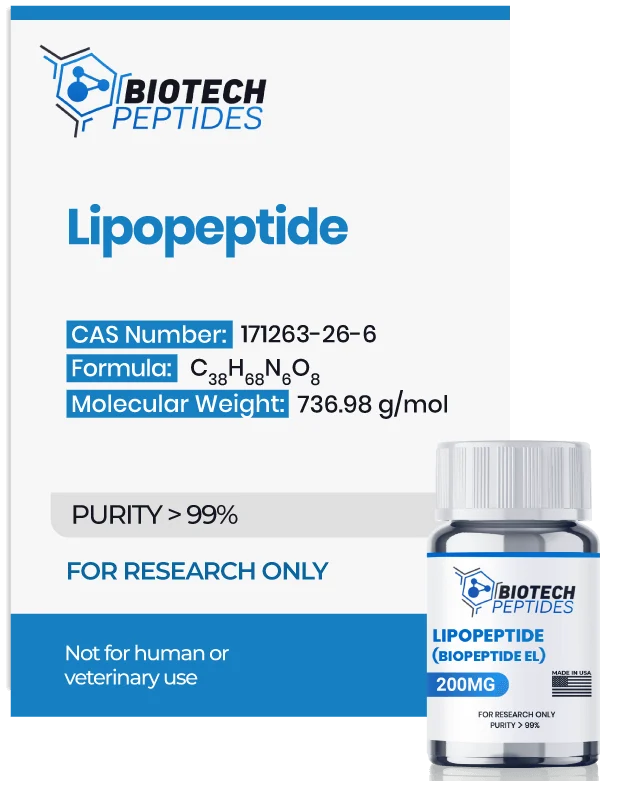
Lipopeptide (Biopeptide EL) (200mg), also known as Palmitoyl Hexapeptide-12, is a lipid-modified hexapeptide containing the elastin-associated VGVAPG amino acid sequence.
Listed by Biotech Peptides for laboratory and analytical research, this compound is of scientific interest in studies involving elastin-derived peptides, fibroblast interactions and extracellular matrix biology.
Product information:
- Product name: Lipopeptide (Biopeptide EL)
- Listed quantity: 200mg
- Chemical name: Palmitoyl Hexapeptide-12
- Peptide sequence: Val-Gly-Val-Ala-Pro-Gly (VGVAPG)
- Molecular formula: C₃₈H₆₈N₆O₈
- Molecular weight: Approximately 737.0 g/mol
- CAS number: 171263-26-6
Explore our research peptides for sale for additional laboratory research materials.
For laboratory and analytical research only. Not for human or animal consumption, personal administration, medical treatment, diagnosis, or veterinary application.
Lipopeptide (Biopeptide EL) (200mg) – Palmitoyl Hexapeptide-12
Lipopeptide (Biopeptide EL) (200mg), also known as Palmitoyl Hexapeptide-12, is a synthetic lipid-modified hexapeptide containing the amino acid sequence Val-Gly-Val-Ala-Pro-Gly (VGVAPG). This sequence is associated with elastin, a structural protein found in connective tissue.
Offered by Biotech Peptides for laboratory and analytical research, Palmitoyl Hexapeptide-12 is of scientific interest because of its relationship to elastin-derived peptide research, fibroblast interactions and extracellular matrix biology.
Researchers investigating peptide chemistry and elastin-associated cellular pathways may find this compound relevant to studies examining lipid-modified peptides and peptide–cell interactions.
What Is Lipopeptide (Biopeptide EL) (200mg)?
Lipopeptide (Biopeptide EL) is the commonly used product name for Palmitoyl Hexapeptide-12. It consists of the VGVAPG hexapeptide sequence with a palmitoyl group attached to its N-terminus.
A palmitoyl group is a 16-carbon fatty-acid-derived modification. In peptide chemistry, lipid modifications are structural features that can influence the physicochemical characteristics of a molecule.
The distinction between Palmitoyl Hexapeptide-12 and unmodified VGVAPG is important when reviewing scientific literature. Although they share the same six-amino-acid sequence, they are chemically different molecules.
Palmitoyl Hexapeptide-12 is also recognised by the cosmetic ingredient name Biopeptide EL. This alternative name should not be confused with evidence of a particular cosmetic or biological outcome.
Palmitoyl Hexapeptide-12 and Elastin Research
Elastin is an extracellular matrix protein that contributes to the elastic properties of connective tissues. It is found in structures such as skin, blood vessels and ligaments.
VGVAPG is a repeating amino-acid sequence found in elastin and its precursor, tropoelastin. Researchers have investigated this sequence as part of broader studies into elastin-derived peptides and cellular interactions.
Palmitoyl Hexapeptide-12 incorporates this sequence with an additional lipid modification. This makes it relevant to research examining the structural differences between unmodified elastin-associated peptides and their lipidated derivatives.
The distinction is particularly important when interpreting experimental findings because results obtained with unmodified VGVAPG cannot automatically be attributed to Palmitoyl Hexapeptide-12.
Research Background: VGVAPG and Fibroblast Interactions
One of the established research areas involving VGVAPG concerns chemotaxis, a process in which cells move in response to a chemical signal.
In a 1984 study published in the Journal of Cell Biology, Senior and colleagues investigated the chemotactic activity of the elastin-derived VGVAPG sequence.
The researchers reported that unmodified VGVAPG attracted fibroblasts and monocytes in experimental assays, with optimal activity observed at approximately 10⁻⁸ M.
The investigation also found that fibroblast responsiveness depended on cellular differentiation and the onset of elastin production.
These findings provide a scientific reference for studying elastin-derived peptide interactions with connective-tissue cells. However, the study investigated unmodified VGVAPG rather than the palmitoylated compound.
Scientific reference: Senior et al. (1984) – VGVAPG chemotactic activity in fibroblasts and monocytes.
Fibroblast Proliferation and Elastin Expression
Further research into VGVAPG examined its relationship with human skin fibroblast proliferation and elastin expression.
A 1997 publication by Tajima and colleagues, titled Modulation by elastin peptide VGVAPG of cell proliferation and elastin expression in human skin fibroblasts, investigated these research areas.
The publication is relevant to understanding how elastin-derived peptide sequences have been studied in relation to fibroblast behaviour and extracellular matrix biology.
It is important to distinguish this work from direct evidence for Palmitoyl Hexapeptide-12. The publication investigated the VGVAPG peptide, and its findings should not be presented as independently establishing the activity of the palmitoylated derivative.
Scientific reference: Tajima et al. (1997) – VGVAPG, fibroblast proliferation and elastin expression.
Extracellular Matrix Research
The extracellular matrix (ECM) is a network of proteins and other molecules surrounding cells. It provides structural support and participates in processes involved in cellular communication and tissue organisation.
Fibroblasts are important cells in extracellular matrix research because they produce and organise structural components, including collagen, elastin and fibronectin.
Research involving elastin-derived peptides such as VGVAPG provides a basis for investigating interactions between extracellular matrix fragments and connective-tissue cells.
Palmitoyl Hexapeptide-12 is of additional interest in peptide chemistry because its palmitoyl modification distinguishes it from the unmodified elastin-associated sequence.
When evaluating this research area, it is important to distinguish between:
- Studies involving unmodified VGVAPG.
- Studies involving Palmitoyl Hexapeptide-12.
- Research involving other lipid-modified peptides.
- Experiments using multi-ingredient cosmetic formulations.
These materials and experimental conditions are not interchangeable, and findings from one should not automatically be attributed to another.
Lipopeptide (Biopeptide EL) (200mg) – Reference Specifications
The following table presents the recognised chemical reference information for Palmitoyl Hexapeptide-12.
| Characteristic | Reference information |
|---|---|
| Product name | Lipopeptide (Biopeptide EL) |
| Listed quantity | 200mg |
| Recognised chemical name | Palmitoyl Hexapeptide-12 |
| Alternative name | Biopeptide EL |
| Peptide length | 6 amino acids |
| Peptide sequence | Val-Gly-Val-Ala-Pro-Gly |
| Sequence abbreviation | VGVAPG |
| Full sequence notation | Pal-Val-Gly-Val-Ala-Pro-Gly-OH |
| Molecular formula | C₃₈H₆₈N₆O₈ |
| Molecular weight | Approximately 737.0 g/mol |
| CAS number | 171263-26-6 |
| PubChem CID | 10212452 |
Understanding the Chemical Structure
Palmitoyl Hexapeptide-12 contains six amino acids and an N-terminal palmitoyl modification.
The reference structure includes:
- A palmitoyl group attached to the N-terminus.
- A valine-glycine-valine-alanine-proline-glycine peptide sequence.
- A C-terminal carboxylic acid group.
These structural characteristics distinguish Palmitoyl Hexapeptide-12 from the unmodified VGVAPG sequence.
The molecular formula, molecular weight, CAS number and sequence are reference characteristics obtained from chemical database information. They do not independently confirm the identity, purity, chemical form or analytical characteristics of the supplied product batch.
The listed 200mg quantity represents the stated product listing quantity, not an independently verified assay result.
Chemical reference: PubChem – Palmitoyl Hexapeptide-12, CID 10212452.
Buy Lipopeptide (Biopeptide EL) from Biotech Peptides
Biotech Peptides offers Lipopeptide (Biopeptide EL) (200mg) as part of its research peptide collection.
Researchers comparing peptides for sale can review the product’s listed identity, reference chemical characteristics and available product documentation before selecting laboratory materials.
If you are looking to buy peptides or compare different research peptide products, our research peptide collection provides access to additional listed compounds.
When comparing cheap peptides or other research materials from different suppliers, consider the available product specifications and batch-specific analytical documentation rather than relying on price alone. A lower listed price does not establish chemical identity, purity or analytical quality.
Documentation and Batch Verification
Reference chemical information is useful when identifying a compound, but it should not be confused with analytical evidence for an individual product batch.
For product-specific identity, purity and analytical characteristics, consult the documentation associated with the relevant lot.
Where available, a Certificate of Analysis (COA) and supporting analytical results may provide information such as:
- Product and batch identification.
- Analytical methods used.
- Reported analytical results.
- Measured purity or assay information, where available.
A COA should be reviewed in relation to the specific batch rather than treated as a general guarantee of every product characteristic.
For additional information, visit our research peptide collection, shipping policy and Research Use Only notice.
Frequently Asked Questions
What is Lipopeptide (Biopeptide EL)?
Lipopeptide (Biopeptide EL) is another name used for Palmitoyl Hexapeptide-12, a lipid-modified hexapeptide containing the VGVAPG amino-acid sequence.
What is Palmitoyl Hexapeptide-12?
Palmitoyl Hexapeptide-12 is a synthetic peptide consisting of the VGVAPG sequence with a palmitoyl group attached to its N-terminus.
What does VGVAPG stand for?
VGVAPG represents the six amino acids in the peptide sequence: valine, glycine, valine, alanine, proline and glycine.
What is the molecular weight of Palmitoyl Hexapeptide-12?
The reference molecular weight is approximately 737.0 g/mol, according to the PubChem chemical database.
Is Palmitoyl Hexapeptide-12 the same as VGVAPG?
No. Both contain the same six-amino-acid sequence, but Palmitoyl Hexapeptide-12 has an additional palmitoyl group attached to its N-terminus. This modification makes it a chemically distinct molecule.
What research has been conducted on VGVAPG?
Published research has investigated VGVAPG in relation to fibroblast and monocyte chemotaxis, fibroblast proliferation and elastin expression. These studies concern the unmodified peptide and should not automatically be interpreted as evidence for the palmitoylated derivative.
Is batch-specific documentation available?
The availability of batch-specific documentation should be confirmed for the relevant product lot. Where a Certificate of Analysis is available, it can provide additional information about the reported analytical characteristics of that batch.
Research Use Only
Lipopeptide (Biopeptide EL) (200mg) is listed by Biotech Peptides for laboratory and analytical research.
For laboratory and analytical research only. Not for human or animal consumption, personal administration, medical treatment, diagnosis, or veterinary application.
Researchers should review the relevant product information, available documentation and applicable handling requirements before selecting any material for laboratory work.
| Brand | Biotech Peptides |
|---|
Related products


ARA-290 (16mg)
ARA-290 (16mg) is offered by Biotech Peptides for laboratory and analytical research. Also called cibinetide, ARA-290 is a synthetic 11-residue peptide derived from the beta-helix domain of erythropoietin, studied in relation to innate repair receptor signaling and inflammatory pathways. 1181
-
Product: ARA-290
-
Alternative name: Cibinetide
-
Listed quantity: 16 mg
-
Reference molecular formula: C₅₁H₅₄N₁₆O₂₁
-
Intended use: Laboratory and analytical research only
Review the manufacturer specifications and applicable analytical documentation before selecting material for your protocol.
For research use only. Not for human consumption.
Decapeptide-12 (200mg)
Decapeptide-12 (200mg), also known by its sequence YRSRKYSSWY, is a synthetic ten-amino-acid peptide investigated for its interaction with tyrosinase and its role in experimental melanogenesis research. Published studies have examined its effects on tyrosinase activity and melanin content in laboratory models. Listed for laboratory and analytical research.



Oxytocin (10mg)
Oxytocin (10mg) is offered by Biotech Peptides for laboratory and analytical research. Oxytocin is a cyclic nonapeptide hormone and neuropeptide studied in relation to social behavior, reproduction, wound healing, and muscle regeneration. 1015
-
Product: Oxytocin
-
Alternative name: Endopituitrina
-
Listed quantity: 10 mg
-
Reference molecular formula: C₄₃H₆₆N₁₂O₁₂S₂
-
Intended use: Laboratory and analytical research only
Review the manufacturer specifications and applicable analytical documentation before selecting material for your protocol.
For research use only. Not for human consumption.
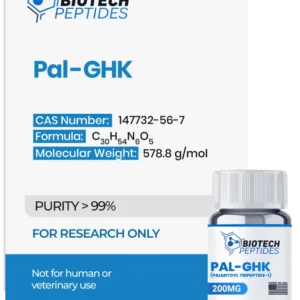
Pal-GHK (Palmitoyl Tripeptide-1) (200mg) | Biotech Peptides
Pal-GHK (Palmitoyl Tripeptide-1) (200mg) is a synthetic, lipid-modified tripeptide listed for laboratory and analytical research involving peptide chemistry and skin-related research models.
Also known as Palmitoyl-Gly-His-Lys, Pal-GHK consists of a palmitoyl group attached to the N-terminus of the GHK tripeptide sequence. It has been investigated in research involving extracellular matrix components and topical cosmetic formulations. Reference molecular information:- Listed quantity: 200mg
- Peptide sequence: Gly-His-Lys (GHK)
- N-terminal modification: Palmitoyl group
- Molecular formula: C₃₀H₅₄N₆O₅
- Molecular weight: 578.8 g/mol
- CAS number: 147732-56-7
- Common name: Palmitoyl Tripeptide-1
PT-141 (Bremelanotide) (10mg)
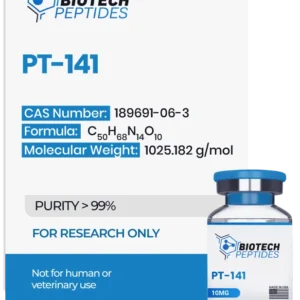
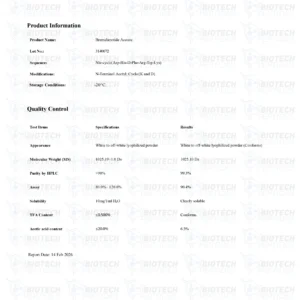
PT-141 (Bremelanotide) (10mg) is offered by Biotech Peptides for laboratory and analytical research. Also called bremelanotide, this synthetic cyclic heptapeptide is a melanocortin receptor agonist studied in relation to MC1R, MC3R, and MC4R signaling.accessdata.fda+2
-
Product: PT-141 (Bremelanotide)
-
Alternative name: Bremelanotide
-
Listed quantity: 10 mg
-
Reference molecular formula: C₅₀H₆₈N₁₄O₁₀
-
Intended use: Laboratory and analytical research only
Review the manufacturer specifications and applicable analytical documentation before selecting material for your protocol.
For research use only. Not for human consumption.


Tesamorelin (5mg & 10mg)
Tesamorelin (5mg & 10mg) is offered by Biotech Peptides for laboratory and analytical research. Tesamorelin is a synthetic 44-residue GHRH analogue studied in relation to growth hormone secretion, visceral adiposity, and metabolic signaling. 1137
-
Product: Tesamorelin
-
Full name: N-(trans-3-hexenoyl)-[Tyr1]-hGRF(1-44)-NH2 acetate
-
Listed quantities: 5 mg and 10 mg
-
Reference molecular formula: C₂₂₁H₃₆₆N₇₂O₆₇S
-
Intended use: Laboratory and analytical research only
Review the manufacturer specifications and applicable analytical documentation before selecting material for your protocol.
For research use only. Not for human consumption.
Thymalin (25mg)
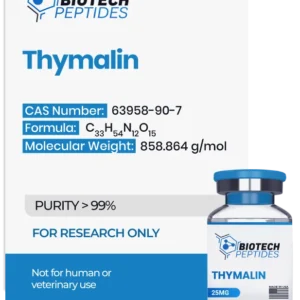
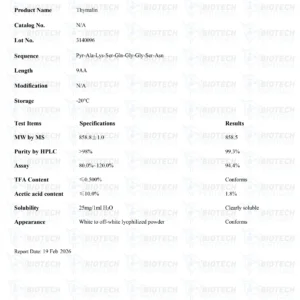
Thymalin (25mg) is offered by Biotech Peptides for laboratory and analytical research. Thymalin is a synthetic 9-residue peptide, also called thymulin, studied in relation to immune modulation, cytokine signaling, and neuroendocrine pathways. 1226
-
Product: Thymalin
-
Alternative name: Thymulin
-
Listed quantity: 25 mg
-
Reference molecular formula: C₃₃H₅₄N₁₂O₁₅
-
Intended use: Laboratory and analytical research only
Review the manufacturer specifications and applicable analytical documentation before selecting material for your protocol.
For research use only. Not for human consumption.