

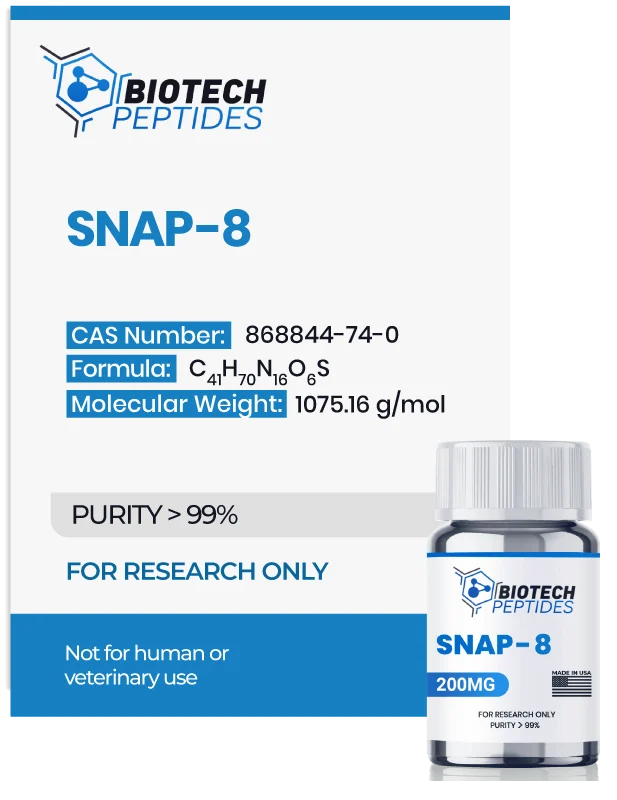
SNAP-8 (200mg)
$172.00
SNAP-8 (200mg) is offered by Biotech Peptides for laboratory and analytical research. Also called acetyl octapeptide-3, this synthetic octapeptide has been studied in relation to SNARE-complex signaling and neurotransmitter release.pmc.ncbi.nlm.nih+1
-
Product: SNAP-8
-
Alternative name: Acetyl octapeptide-3
-
Listed quantity: 200 mg
-
Reference sequence: Ac-Glu-Glu-Met-Gln-Arg-Arg-Ala-Asp-NH₂
-
Intended use: Laboratory and analytical research only
Review the manufacturer specifications and applicable analytical documentation before selecting material for your protocol.
For research use only. Not for human consumption.
SNAP-8 (200mg) for Laboratory Research
SNAP-8 (200mg) is offered by Biotech Peptides for laboratories investigating peptide interactions with SNARE-complex biology and neurotransmitter-release pathways. SNAP-8, also called acetyl octapeptide-3, is an eight-amino-acid synthetic peptide patterned on a segment of SNAP-25.chemverify+1
For laboratories looking to buy SNAP-8, this listing identifies a 200 mg quantity. Confirm the supplied material’s sequence, terminal groups, chemical form, and analytical characteristics against the requirements of the intended work.
Explore our research peptides for sale to review other laboratory-use listings.
SNAP-8 Product Information
| Property | Listing information |
|---|---|
| Product name | SNAP-8 |
| Alternative name | Acetyl octapeptide-3 |
| Listed quantity | 200 mg |
| Intended application | Laboratory and analytical research |
| Documentation inquiries | Include the product name and batch or lot number, where available |
The 200 mg designation describes the quantity stated for this listing. It does not independently establish net peptide content or confirm that a particular quantity-assay method has been performed.
SNAP-8 Reference Molecular Characteristics
The following characteristics describe the unmodified SNAP-8 reference structure. They are not analytical confirmation of an individual commercial batch.
| Reference characteristic | Information |
|---|---|
| Peptide length | Eight amino acids |
| Amino-acid sequence | Ac-Glu-Glu-Met-Gln-Arg-Arg-Ala-Asp-NH₂ |
| One-letter sequence | Ac-EEMQRRAD-NH₂ |
| N-terminal group | Acetyl |
| C-terminal group | Amide |
| Molecular formula | C₄₁H₇₀N₁₆O₁₆S |
| Approximate molecular weight | 1,075.16 g/mol |
| PubChem compound identifier | 71587832 |
The sequence, terminal modifications, molecular formula, and approximate molecular weight are documented in the SNAP-8 reference record. Confirm the supplied chemical form and any counterions against manufacturer specifications before using reference values in analytical calculations.chemverify+1
SNARE-Complex Research Context
Neuronal exocytosis requires assembly of SNARE proteins, including syntaxin, SNAP-25, and synaptobrevin. These proteins form a four-helix bundle that participates in vesicle fusion and neurotransmitter release.
SNAP-8 is a short synthetic peptide designed to resemble part of SNAP-25. Its proposed research mechanism involves interference with SNARE-complex assembly rather than direct cleavage or destruction of SNAP-25.chemverify+1
Read the review of SNARE-complex formation for the molecular context of vesicle fusion and neurotransmitter release.
Glutamate-Release Research
The 43% glutamate-release inhibition figure is commonly attributed to manufacturer-sponsored in vitro testing. Published independent clinical evidence specific to SNAP-8 alone remains limited.peptidejournal+1
A reported in vitro result should not be presented as a clinical outcome. It describes a defined assay system, not the effect of a commercial batch in skin, muscle, or a living organism.peptidejournal+1
Wrinkle-Depth Claims
Claims of 35% average or up to 62% to 63% wrinkle-depth reduction are associated with manufacturer-funded cosmetic testing. Independent reviews describe the clinical evidence for acetyl octapeptide-3 as limited, and the available human studies often use multi-ingredient products rather than SNAP-8 alone.peptidejournal+1
A reduction in wrinkle depth is not established for a research-use SNAP-8 material. Skin penetration, formulation, concentration, exposure duration, and study design all affect any observed cosmetic result.
Distinguishing SNAP-8 From SNAP-25
Before applying a publication to your protocol, confirm that its experimental material matches the supplied peptide.
Do not assume that “SNAP-8,” “SNAP-25,” “acetyl octapeptide-3,” or “acetyl hexapeptide-3” identifies the same material. SNAP-25 is a 25 kDa SNARE protein, while SNAP-8 is an eight-amino-acid synthetic peptide designed to mimic a short SNAP-25-derived sequence.pmc.ncbi.nlm.nih+1
Likewise, results involving Argireline, Leuphasyl, or a multi-ingredient cosmetic formulation should not be presented as verified properties of an isolated SNAP-8 batch.peptidejournal+1
Research Limitations
Published SNAP-8 research examines in vitro neurotransmitter-release assays and limited cosmetic-product studies. It does not establish that SNAP-8 reduces wrinkles, relaxes muscles, improves skin hydration, protects against oxidative stress, or treats any condition.peptidejournal+1
Published research also does not verify the identity, purity, quantity, or biological activity of the commercial batch supplied with this listing.
Documentation and Batch Verification
Before selecting SNAP-8 (200mg), review the information associated with the exact material being supplied. Depending on your protocol, relevant documentation may include:
-
Product name and batch or lot identifier.
-
Manufacturer specifications and chemical form.
-
Complete sequence and terminal-group information.
-
Counterion information, where applicable.
-
Identity-testing methods and reported results.
-
Purity-testing methods and supporting analytical data.
-
Quantity or peptide-content measurements, where required.
-
Product-specific storage and handling instructions.
Match identifiers across the label, specifications, and analytical reports. Obtain clarification if the documentation uses inconsistent names, sequences, or molecular values.
For inquiries, provide “SNAP-8 (200mg),” the batch number where available, and the specific information your laboratory requires.
Storage and Handling
Follow the product-specific instructions supplied with the material and your laboratory’s applicable procedures.
Do not transfer storage temperatures, shelf-life claims, or preparation instructions from another supplier’s formulation or a differently modified peptide. Obtain clarification if documented instructions are unavailable or unclear.
Frequently Asked Questions About SNAP-8 (200mg)
What is SNAP-8?
SNAP-8 is acetyl octapeptide-3, an eight-amino-acid synthetic peptide with the sequence Ac-Glu-Glu-Met-Gln-Arg-Arg-Ala-Asp-NH₂.chemverify+1
Is SNAP-8 the same as SNAP-25?
No. SNAP-25 is a larger SNARE protein involved in vesicle fusion and neurotransmitter release. SNAP-8 is a short synthetic peptide designed to mimic part of SNAP-25.pmc.ncbi.nlm.nih+1
Is SNAP-8 the same as botulinum toxin?
No. Botulinum toxin cleaves SNARE proteins, while SNAP-8 is a short synthetic peptide proposed to interfere with SNARE-complex assembly through a different mechanism.pmc.ncbi.nlm.nih+1
Does 200mg describe a concentration?
No. It is the quantity stated for this listing. It does not describe a concentration or independently establish net peptide content.
Does published research verify this product?
No. Publications and manufacturer-sponsored studies describe the materials and conditions used by the investigators. Assess a commercial batch using relevant manufacturer specifications and analytical evidence.
Where can I find delivery information?
Review our shipping information for current order-processing and delivery terms.
Research Use Only
SNAP-8 (200mg) is sold for laboratory and analytical research only. Not for human or animal consumption, personal administration, medical treatment, diagnosis, or veterinary application.
Review our Research-Use-Only Policy before ordering.
| Brand | Biotech Peptides |
|---|
Related products


ARA-290 (16mg)
ARA-290 (16mg) is offered by Biotech Peptides for laboratory and analytical research. Also called cibinetide, ARA-290 is a synthetic 11-residue peptide derived from the beta-helix domain of erythropoietin, studied in relation to innate repair receptor signaling and inflammatory pathways. 1181
-
Product: ARA-290
-
Alternative name: Cibinetide
-
Listed quantity: 16 mg
-
Reference molecular formula: C₅₁H₅₄N₁₆O₂₁
-
Intended use: Laboratory and analytical research only
Review the manufacturer specifications and applicable analytical documentation before selecting material for your protocol.
For research use only. Not for human consumption.

Lipopeptide (Biopeptide EL) (200mg)
- Product name: Lipopeptide (Biopeptide EL)
- Listed quantity: 200mg
- Chemical name: Palmitoyl Hexapeptide-12
- Peptide sequence: Val-Gly-Val-Ala-Pro-Gly (VGVAPG)
- Molecular formula: C₃₈H₆₈N₆O₈
- Molecular weight: Approximately 737.0 g/mol
- CAS number: 171263-26-6


Pal-AHK (200mg) | Biotech Peptides
Pal-AHK (200mg) is listed as a palmitoylated AHK tripeptide for laboratory and analytical research. The supplied product description identifies the proposed structure as palmitoyl-Ala-His-Lys, combining an alanine-histidine-lysine peptide sequence with an N-terminal palmitoyl group.
Proposed reference characteristics (subject to manufacturer confirmation):- Listed quantity: 200mg
- Proposed peptide sequence: Ala-His-Lys (AHK)
- Proposed modification: N-terminal palmitoyl group
- Proposed molecular formula: C₃₁H₅₆N₆O₅
- Proposed molecular weight: Approximately 592.8 g/mol
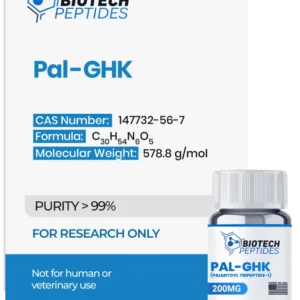
Pal-GHK (Palmitoyl Tripeptide-1) (200mg) | Biotech Peptides
Pal-GHK (Palmitoyl Tripeptide-1) (200mg) is a synthetic, lipid-modified tripeptide listed for laboratory and analytical research involving peptide chemistry and skin-related research models.
Also known as Palmitoyl-Gly-His-Lys, Pal-GHK consists of a palmitoyl group attached to the N-terminus of the GHK tripeptide sequence. It has been investigated in research involving extracellular matrix components and topical cosmetic formulations. Reference molecular information:- Listed quantity: 200mg
- Peptide sequence: Gly-His-Lys (GHK)
- N-terminal modification: Palmitoyl group
- Molecular formula: C₃₀H₅₄N₆O₅
- Molecular weight: 578.8 g/mol
- CAS number: 147732-56-7
- Common name: Palmitoyl Tripeptide-1
PT-141 (Bremelanotide) (10mg)
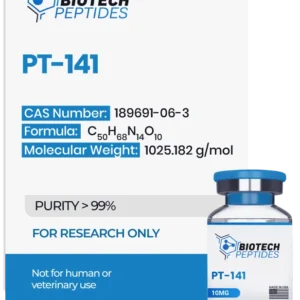
PT-141 (Bremelanotide) (10mg) is offered by Biotech Peptides for laboratory and analytical research. Also called bremelanotide, this synthetic cyclic heptapeptide is a melanocortin receptor agonist studied in relation to MC1R, MC3R, and MC4R signaling.accessdata.fda+2
-
Product: PT-141 (Bremelanotide)
-
Alternative name: Bremelanotide
-
Listed quantity: 10 mg
-
Reference molecular formula: C₅₀H₆₈N₁₄O₁₀
-
Intended use: Laboratory and analytical research only
Review the manufacturer specifications and applicable analytical documentation before selecting material for your protocol.
For research use only. Not for human consumption.


TB-500 (Thymosin Beta-4) (10mg)
TB-500 (Thymosin Beta-4) (10mg) is offered by Biotech Peptides for laboratory and analytical research. TB-500 is a synthetic 43-residue peptide derived from thymosin beta-4, studied in relation to cell migration, angiogenesis, and wound-repair signaling. 1153
-
Product: TB-500
-
Full name: Thymosin Beta-4
-
Listed quantity: 10 mg
-
Reference molecular formula: C₂₁₂H₃₅₀N₅₆O₇₈S
-
Intended use: Laboratory and analytical research only
Review the manufacturer specifications and applicable analytical documentation before selecting material for your protocol.
For research use only. Not for human consumption.