


Vialox (Pentapeptide-3V) (200mg)
$210.00
Vialox (Pentapeptide-3V) peptides are Synthesized and Lyophilized in the USA.
.ins01, .ins02, .ins03, .ins04 {display:none}
Vialox (Pentapeptide-3V) Peptide
Vialox, also known as Pentapeptide-3V, is a peptide with a five amino acid sequence (Gly-Pro-Arg-Pro-Ala). It was originally isolated from endogenously produced snake venom. The peptide appears to replicate temporary muscular paralysis. This result has been observed by researchers in paralytic compounds such as botulinum toxin, which are believed to reduce wrinkle depth. Vialox appears to inhibit nicotinic acetylcholine receptors. This potential may enable curare-like actions at the neuromuscular junction, which might block nervous system electrical impulses from reaching muscles. A block like this may ultimately halt muscle contraction.
This mechanism appears to be analogous to the function of tubocurarine. This function is observed through Vialox’s hypothetical interaction with acetylcholine receptors on the postsynaptic membrane of muscle cells. Tubocurarine, a naturally occurring alkaloid compound, is primarily found in the bark of certain plants. This includes Chondrodendron tomentosum, commonly referred to as “curare.” Experts recognize this compound as a potent neurotoxin. Its mode of action is considered to function as a non-depolarizing neuromuscular blocker. It is hypothesized that this function obstructs the activity of acetylcholine—a neurotransmitter deemed by researchers to be critical for muscle contraction—at the neuromuscular junction, which might inhibit muscle contraction.[1]
Specifications
Sequence: Gly-Pro-Arg-Pro-Ala
Molecular Formula: C21H37N9O5
Molecular Weight: 495.58 g/mol
PubChem: CID 67073230
Synonyms: Pentapeptide-3V
Vialox Peptide Research
Vialox (Pentapeptide-3V) and General Studies
Vialox (Pentapeptide-3V) is a peptide of interest to scientists because of its suggested propensity to disrupt nerve-muscle communication. Unlike other nicotinic acetylcholine receptor (N-AChR) antagonists, Vialox appears to operate solely on peripheral nicotinic acetylcholine receptors. According to studies on animal test models, the peptide may not have much impact on central neuronal receptors.
Vialox appears to disrupt signal transmission between neurons and muscles. Researchers explain that it may be an antagonist of the acetylcholine receptor and that it might block nerves at the post-synaptic membrane. This blockage may lead to muscle relaxation.[2] Scientific studies posit that acetylcholine, once released from the nerve’s axon, may travel to the neuromuscular junction and bind to receptors on the muscle cell membrane, such as nicotinic acetylcholine receptors (N-AChR). The binding of the axon to the receptor might allow an influx of sodium ions into the muscle cell, which may lead to depolarization (the reduction of the electrical charge across the cell membrane). Depolarization may initiate an electrical pulse that may trigger muscle contraction.
Vialox has been studied for its theoretical ability to halt this process by attaching to N-AChR. The peptide appears to inhibit the attachment of acetylcholine, a neurotransmitter, to its specific receptor sites on muscle cells. This inhibition likely prevents the subsequent opening of sodium ion channels, which experts consider to be crucial for the depolarization process that typically results in muscle contraction. By interfering with acetylcholine receptor activity, Vialox may function as a non-depolarizing neuromuscular blocker. Consequently, it may contribute to smooth muscles, such as those found in various internal organs, remaining relaxed.[3]
The overall hypothetical action of Vialox is a decrease in acetylcholine binding as well as a possible decrease in the frequency and intensity of muscular contraction. Following the partial paralysis of the muscles, forced relaxation is typically observed. Studies on the subject have implied that the peptide may reduce muscle contractions by 71% within 1 minute of experimentation. Vialox may have contributed to a 58% reduction in muscle contractions a full 2 hours later. Consequently, Gorouhi et al. commented that “…in vitro studies […] showed that this product [may have led to] softened wrinkles and reduced skin roughness“.[3]
Vialox (Pentapeptide-3V) and Wrinkles
The aging process of skin structure includes a decline in the levels of skin cells, which are thought to include astrocytes. Astrocytes are theorized to be responsible for the production of proteins like collagen. Natural aging may also result in a decline in levels of proteins like collagen and elastin. A decline in the levels of these proteins may lead to increased wrinkling of the top layers of the skin structure.
According to studies conducted by specialists in the Department of Dermatology, Reddy et al. noted “this product [may be] effective in smoothing [and]…immediate[ly] tightening the skin.” Experimental models suggest that Vialox may eliminate wrinkles in 50% of the experimental cohort and skin surface roughness in around 47% of the experimental cohort after 28 days of twice-daily exposure.[4]
Disclaimer: The products mentioned are not intended for human or animal consumption. Research chemicals are intended solely for laboratory experimentation and/or in-vitro testing. Bodily introduction of any sort is strictly prohibited by law. All purchases are limited to licensed researchers and/or qualified professionals. All information shared in this article is for educational purposes only.
References
- Husein el Hadmed, H., & Castillo, R. F. (2016). Cosmeceuticals: peptides, proteins, and growth factors. Journal of cosmetic dermatology, 15(4), 514-519.
- Lupo, M. P., & Cole, A. L. (2007). Cosmeceutical peptides. Dermatologic therapy, 20(5), 343-349.
- Gorouhi, F., & Maibach, H. I. (2009). Role of topical peptides in preventing or treating aged skin. International journal of cosmetic science, 31(5), 327-345.
- Reddy, B. Y., Jow, T., & Hantash, B. M. (2012). Bioactive oligopeptides in dermatology: Part II. Experimental dermatology, 21(8), 569-575.
| Brand | Biotech Peptides |
|---|
Related products

Acetyl Hexapeptide-3 (Argireline) (200mg)
- Product: Acetyl Hexapeptide-3 (Argireline)
- Listed quantity: 200mg
- Alternative name: Acetyl Hexapeptide-8
- Sequence: Ac-Glu-Glu-Met-Gln-Arg-Arg-NH₂
- CAS number: 616204-22-9
- Research area: SNAP-25 and SNARE-complex interactions


ARA-290 (16mg)
ARA-290 (16mg) is offered by Biotech Peptides for laboratory and analytical research. Also called cibinetide, ARA-290 is a synthetic 11-residue peptide derived from the beta-helix domain of erythropoietin, studied in relation to innate repair receptor signaling and inflammatory pathways. 1181
-
Product: ARA-290
-
Alternative name: Cibinetide
-
Listed quantity: 16 mg
-
Reference molecular formula: C₅₁H₅₄N₁₆O₂₁
-
Intended use: Laboratory and analytical research only
Review the manufacturer specifications and applicable analytical documentation before selecting material for your protocol.
For research use only. Not for human consumption.
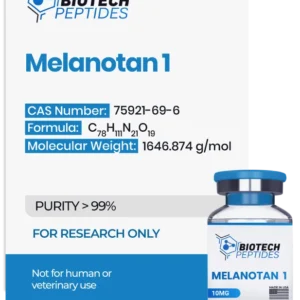
Melanotan 1 (10mg)
Melanotan 1 (10mg) is offered by Biotech Peptides for laboratory and analytical research. Also called afamelanotide, this synthetic 13-residue analogue of alpha-melanocyte-stimulating hormone has been studied in relation to melanocortin receptor signaling and melanin production.pmc.ncbi.nlm.nih+1
-
Product: Melanotan 1
-
Alternative name: Afamelanotide
-
Listed quantity: 10 mg
-
Reference molecular formula: C₇₈H₁₁₁N₂₁O₁₉
-
Intended use: Laboratory and analytical research only
Review the manufacturer specifications and applicable analytical documentation before selecting material for your protocol.
For research use only. Not for human consumption.
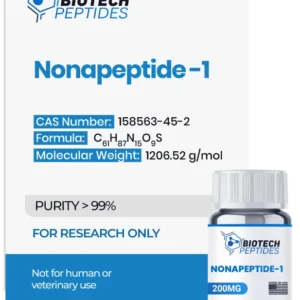
Nonapeptide-1 (200mg)
- Product: Nonapeptide-1
- Alternative name: Melanostatine-5
- Listed quantity: 200mg
- Peptide length: 9 amino acids
- Reference sequence: Met-Pro-D-Phe-Arg-D-Trp-Phe-Lys-Pro-Val-NH₂
- CAS number: 158563-45-2


Oxytocin (10mg)
Oxytocin (10mg) is offered by Biotech Peptides for laboratory and analytical research. Oxytocin is a cyclic nonapeptide hormone and neuropeptide studied in relation to social behavior, reproduction, wound healing, and muscle regeneration. 1015
-
Product: Oxytocin
-
Alternative name: Endopituitrina
-
Listed quantity: 10 mg
-
Reference molecular formula: C₄₃H₆₆N₁₂O₁₂S₂
-
Intended use: Laboratory and analytical research only
Review the manufacturer specifications and applicable analytical documentation before selecting material for your protocol.
For research use only. Not for human consumption.


Tesamorelin (5mg & 10mg)
Tesamorelin (5mg & 10mg) is offered by Biotech Peptides for laboratory and analytical research. Tesamorelin is a synthetic 44-residue GHRH analogue studied in relation to growth hormone secretion, visceral adiposity, and metabolic signaling. 1137
-
Product: Tesamorelin
-
Full name: N-(trans-3-hexenoyl)-[Tyr1]-hGRF(1-44)-NH2 acetate
-
Listed quantities: 5 mg and 10 mg
-
Reference molecular formula: C₂₂₁H₃₆₆N₇₂O₆₇S
-
Intended use: Laboratory and analytical research only
Review the manufacturer specifications and applicable analytical documentation before selecting material for your protocol.
For research use only. Not for human consumption.
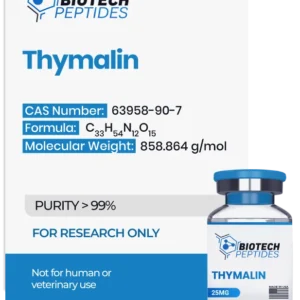
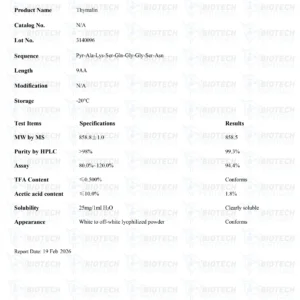
Thymalin (25mg)
Thymalin (25mg) is offered by Biotech Peptides for laboratory and analytical research. Thymalin is a synthetic 9-residue peptide, also called thymulin, studied in relation to immune modulation, cytokine signaling, and neuroendocrine pathways. 1226
-
Product: Thymalin
-
Alternative name: Thymulin
-
Listed quantity: 25 mg
-
Reference molecular formula: C₃₃H₅₄N₁₂O₁₅
-
Intended use: Laboratory and analytical research only
Review the manufacturer specifications and applicable analytical documentation before selecting material for your protocol.
For research use only. Not for human consumption.
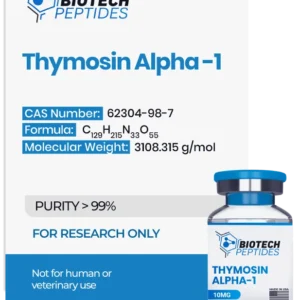
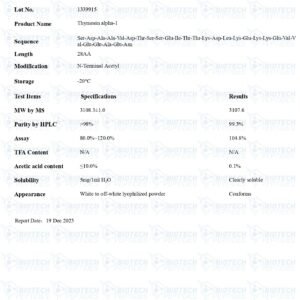
Thymosin Alpha-1 (10mg)
Thymosin Alpha-1 (10mg) is offered by Biotech Peptides for laboratory and analytical research. Thymosin Alpha-1 is a synthetic 28-residue peptide, also called thymalfasin, studied in relation to immune modulation, toll-like receptor signaling, and antiviral research. 1213
-
Product: Thymosin Alpha-1
-
Alternative name: Thymalfasin
-
Listed quantity: 10 mg
-
Reference molecular formula: C₁₂₉H₂₁₅N₃₃O₅₅
-
Intended use: Laboratory and analytical research only
Review the manufacturer specifications and applicable analytical documentation before selecting material for your protocol.
For research use only. Not for human consumption.