


Pal-GHK (Palmitoyl Tripeptide-1) (200mg) | Biotech Peptides
$199.00
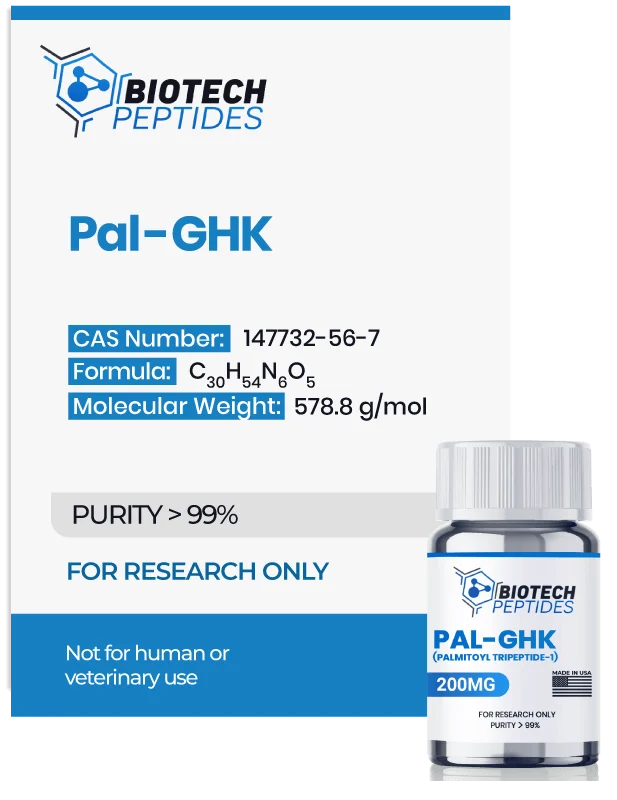
Pal-GHK (Palmitoyl Tripeptide-1) (200mg) is a synthetic, lipid-modified tripeptide listed for laboratory and analytical research involving peptide chemistry and skin-related research models.
Also known as Palmitoyl-Gly-His-Lys, Pal-GHK consists of a palmitoyl group attached to the N-terminus of the GHK tripeptide sequence. It has been investigated in research involving extracellular matrix components and topical cosmetic formulations.
Reference molecular information:
- Listed quantity: 200mg
- Peptide sequence: Gly-His-Lys (GHK)
- N-terminal modification: Palmitoyl group
- Molecular formula: C₃₀H₅₄N₆O₅
- Molecular weight: 578.8 g/mol
- CAS number: 147732-56-7
- Common name: Palmitoyl Tripeptide-1
Explore the Biotech Peptides research peptide collection for additional laboratory research materials.
For laboratory and analytical research only. Not for human or animal consumption, personal administration, medical treatment, diagnosis, or veterinary application.
Pal-GHK (Palmitoyl Tripeptide-1) (200mg) – Product Overview
Pal-GHK (Palmitoyl Tripeptide-1) (200mg) is a synthetic, lipid-modified tripeptide listed for laboratory and analytical research. The molecule consists of the GHK sequence—glycine, histidine and lysine—with a palmitoyl group attached to its N-terminus.
Also called Palmitoyl-Gly-His-Lys, Pal-GHK is studied in the context of peptide chemistry, extracellular matrix research and topical cosmetic formulations. Its structure combines a short peptide sequence with a fatty-acid-derived modification, making it a useful reference compound for research into lipid-modified peptides.
Researchers looking to buy Pal-GHK (Palmitoyl Tripeptide-1) (200mg) can review its reference molecular characteristics and selected research findings below.
Pal-GHK Product Information
| Attribute | Reference information |
|---|---|
| Product name | Pal-GHK (Palmitoyl Tripeptide-1) |
| Listed quantity | 200mg |
| Compound class | Lipid-modified tripeptide |
| Peptide sequence | Gly-His-Lys (GHK) |
| N-terminal modification | Palmitoyl group |
| Structural description | N-palmitoyl-Gly-L-His-L-Lys |
| Molecular formula | C₃₀H₅₄N₆O₅ |
| Molecular weight | 578.8 g/mol |
| CAS number | 147732-56-7 |
| Common alternative name | Palmitoyl-Gly-His-Lys |
The molecular information describes the established reference compound. It does not independently verify the chemical identity, purity, measured content or analytical quality of the specific Biotech Peptides batch.
Reference Molecular Characteristics
Pal-GHK is made up of two structural components:
- Palmitoyl group: A 16-carbon fatty-acid-derived group attached to the peptide’s N-terminal nitrogen.
- GHK sequence: A tripeptide composed of glycine, L-histidine and L-lysine.
The resulting structure is commonly described as N-palmitoyl-glycyl-L-histidyl-L-lysine. Its molecular formula is C₃₀H₅₄N₆O₅ and its molecular weight is 578.8 g/mol.
The palmitoyl modification changes the physicochemical characteristics of the parent GHK sequence, including its lipid affinity. This structural modification is relevant to research into peptide formulation and interactions with lipid-containing biological barriers. It should not, by itself, be interpreted as proof of a particular level of skin penetration or biological activity.
For chemical reference information, see the PubChem record for Palmitoyl Tripeptide-1 and the Cosmetic Ingredient Review assessment.
Scientific Research Background
Extracellular Matrix and Collagen-Related Research
The GHK sequence is associated with a fragment of type I collagen and has been investigated in research involving extracellular matrix biology. The extracellular matrix (ECM) is the network of proteins and other molecules surrounding cells that contributes to tissue structure and cell signaling.
Palmitoyl Tripeptide-1 has been investigated as a cosmetic signal peptide in relation to fibroblast activity and collagen-associated pathways. Fibroblasts are connective-tissue cells that produce components of the extracellular matrix.
A 2014 Cosmetic Ingredient Review assessment describes studies involving Pal-GHK and collagen synthesis in human fibroblast cultures. The assessment also discusses experimental work examining collagen preservation in UVA-exposed human skin samples.
These findings provide research context for the compound. They do not establish that this 200mg product produces a particular biological or cosmetic outcome.
Read the Cosmetic Ingredient Review safety assessment.
Topical Formulation and Skin-Thickness Research
The CIR assessment summarizes a study in which Palmitoyl Tripeptide-1 was applied in a topical vehicle at 4 ppm to 23 healthy female volunteers over four weeks. Ultrasound measurements indicated an approximately 4% increase in skin thickness at the treated site compared with the vehicle site.
The study involved a specific topical formulation and a low ingredient concentration. Its findings should not be generalized to an unformulated research material or interpreted as evidence of an effect from the listed 200mg quantity.
The same assessment also summarizes a separate four-week study involving a cream containing 3 ppm Palmitoyl Tripeptide-1 applied around the eyes of 15 female volunteers. Changes in wrinkle length, wrinkle depth and skin roughness were reported.
These are formulation-specific findings, not product-batch performance claims.
Source: CIR – Safety Assessment of Tripeptide-1 and Related Ingredients (2014).
Research Reviews and Cosmetic Peptide Classification
The 2020 review Trending Anti-Aging Peptides discusses Palmitoyl Tripeptide-1 among peptides used in cosmetic formulations. It describes the compound in the context of signal-peptide research and reports the previously published fibroblast and topical skin-thickness findings.
The review also highlights an important naming issue: the older term “Palmitoyl Oligopeptide” was used for more than one peptide structure. The cosmetic ingredient nomenclature was revised to distinguish Palmitoyl Tripeptide-1 (Pal-GHK) from other palmitoylated peptide sequences.
For clearer scientific identification, this product description uses Palmitoyl Tripeptide-1 and Pal-GHK rather than relying on the less-specific historical synonym alone.
Read the review: Trending Anti-Aging Peptides – Cosmetics (2020).
Important Compound Distinctions
Pal-GHK should not be confused with other GHK-related compounds or palmitoylated peptides.
| Compound | Structural distinction |
|---|---|
| Pal-GHK (Palmitoyl Tripeptide-1) | Palmitoyl group attached to GHK |
| GHK | Unmodified glycyl-histidyl-lysine tripeptide |
| GHK-Cu | GHK complexed with copper |
| Palmitoyl Tetrapeptide-7 | Different palmitoylated peptide with a GQPR sequence |
| Palmitoyl Pentapeptide-4 | Different palmitoylated peptide with a KTTKS sequence |
Research findings involving GHK-Cu, unmodified GHK, Palmitoyl Tetrapeptide-7 or Palmitoyl Pentapeptide-4 should not automatically be attributed to Pal-GHK.
In particular, wound-healing studies involving GHK-Cu or unmodified GHK do not establish wound-healing activity for Palmitoyl Tripeptide-1.
Research Interpretation and Limitations
The available literature provides a basis for investigating Pal-GHK in peptide chemistry and topical formulation research, but important limitations apply:
- Some findings come from cell cultures or ex vivo skin samples rather than intact human systems.
- Human studies involved specific cosmetic formulations and low ingredient concentrations.
- Results from multi-peptide cosmetic blends cannot necessarily be attributed to Pal-GHK alone.
- A reported change in a laboratory or topical research endpoint does not establish a clinical benefit.
- The listed 200mg quantity is not equivalent to the concentrations used in topical formulation studies.
The research findings should therefore be interpreted according to the compound, formulation, concentration, experimental model and endpoint studied.
Documentation and Batch Verification
Reference molecular data are not a substitute for product-specific analytical documentation.
Researchers should consult manufacturer documentation and batch records when verifying:
- Chemical identity and peptide sequence
- N-terminal palmitoyl modification
- Chemical form and any counterions
- Batch-specific analytical results
- Measured quantity and assay information
- Available chromatographic or mass-spectrometry data
No batch-specific Certificate of Analysis, purity percentage, HPLC result, mass-spectrometry result, sterility result or endotoxin result has been supplied for this listing. These specifications should not be assumed.
The listed quantity of 200mg should be treated as the product’s stated quantity, not as an independently verified assay result.
Storage and Handling
Follow the applicable manufacturer instructions and product-specific documentation for storage and handling.
No verified product-specific storage temperature, shelf life or stability period has been supplied for this listing. Specific storage conditions should not be inferred from general information about the reference compound.
Frequently Asked Questions
What is Pal-GHK?
Pal-GHK is Palmitoyl Tripeptide-1, a synthetic tripeptide derivative consisting of a palmitoyl group attached to the GHK sequence: glycine, histidine and lysine.
What is the molecular formula of Palmitoyl Tripeptide-1?
The reference molecular formula is C₃₀H₅₄N₆O₅, and its molecular weight is 578.8 g/mol.
Is Pal-GHK the same as GHK-Cu?
No. Pal-GHK is a palmitoylated form of the GHK tripeptide. GHK-Cu is a copper complex of GHK. They have different chemical structures and should not be treated as interchangeable research materials.
What is the listed quantity?
This Biotech Peptides product is listed as 200mg. The listed quantity should not be interpreted as an independently verified measurement of peptide content without supporting batch documentation.
What research has been conducted on Pal-GHK?
Research has examined Pal-GHK in relation to collagen-associated pathways, fibroblast cultures and topical cosmetic formulations. Some human topical studies have reported changes in measured skin parameters, but these findings apply to the specific formulations and study conditions investigated.
Is this product intended for human or animal use?
No. This product is offered for laboratory and analytical research only. It is not intended for human or animal consumption, personal administration, medical treatment, diagnosis or veterinary application.
Explore Research Peptides
Explore the Biotech Peptides research peptide collection to find additional compounds listed for laboratory and analytical research.
For information about order processing and delivery arrangements, review the Shipping Policy.
Please also read the Research Use Only notice before purchasing.
Research-use restriction: For laboratory and analytical research only. Not for human or animal consumption, personal administration, medical treatment, diagnosis, or veterinary application.
| Brand | Biotech Peptides |
|---|
Related products


ARA-290 (16mg)
ARA-290 (16mg) is offered by Biotech Peptides for laboratory and analytical research. Also called cibinetide, ARA-290 is a synthetic 11-residue peptide derived from the beta-helix domain of erythropoietin, studied in relation to innate repair receptor signaling and inflammatory pathways. 1181
-
Product: ARA-290
-
Alternative name: Cibinetide
-
Listed quantity: 16 mg
-
Reference molecular formula: C₅₁H₅₄N₁₆O₂₁
-
Intended use: Laboratory and analytical research only
Review the manufacturer specifications and applicable analytical documentation before selecting material for your protocol.
For research use only. Not for human consumption.
Melanotan 1 (10mg)
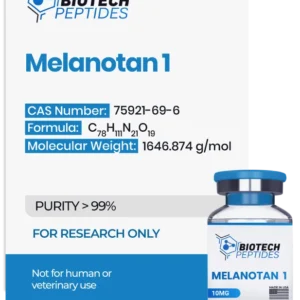
Melanotan 1 (10mg) is offered by Biotech Peptides for laboratory and analytical research. Also called afamelanotide, this synthetic 13-residue analogue of alpha-melanocyte-stimulating hormone has been studied in relation to melanocortin receptor signaling and melanin production.pmc.ncbi.nlm.nih+1
-
Product: Melanotan 1
-
Alternative name: Afamelanotide
-
Listed quantity: 10 mg
-
Reference molecular formula: C₇₈H₁₁₁N₂₁O₁₉
-
Intended use: Laboratory and analytical research only
Review the manufacturer specifications and applicable analytical documentation before selecting material for your protocol.
For research use only. Not for human consumption.


MGF (Mechano-Growth Factor) (5mg)
MGF (Mechano-Growth Factor) (5mg) is offered by Biotech Peptides for laboratory and analytical research. MGF is a synthetic 24-residue peptide derived from the E-domain of IGF-1Ec, studied in relation to muscle-cell proliferation, tissue-repair signaling, and cardiac ischemia models. 1065
-
Product: MGF
-
Full name: Mechano-Growth Factor
-
Listed quantity: 5 mg
-
Reference molecular formula: C₁₂₄H₂₀₄N₄₂O₄₁S
-
Intended use: Laboratory and analytical research only
Review the manufacturer specifications and applicable analytical documentation before selecting material for your protocol.
For research use only. Not for human consumption.


Pal-AHK (200mg) | Biotech Peptides
Pal-AHK (200mg) is listed as a palmitoylated AHK tripeptide for laboratory and analytical research. The supplied product description identifies the proposed structure as palmitoyl-Ala-His-Lys, combining an alanine-histidine-lysine peptide sequence with an N-terminal palmitoyl group.
Proposed reference characteristics (subject to manufacturer confirmation):- Listed quantity: 200mg
- Proposed peptide sequence: Ala-His-Lys (AHK)
- Proposed modification: N-terminal palmitoyl group
- Proposed molecular formula: C₃₁H₅₆N₆O₅
- Proposed molecular weight: Approximately 592.8 g/mol


PEG-MGF (Pegylated MGF) (5mg)
PEG-MGF (Pegylated MGF) (5mg) is offered by Biotech Peptides for laboratory and analytical research. PEG-MGF is a pegylated form of mechano growth factor, a synthetic 24-residue peptide derived from the E-domain of IGF-1Ec. 1002
-
Product: PEG-MGF
-
Full name: Pegylated Mechano Growth Factor
-
Listed quantity: 5 mg
-
Reference molecular formula: C₁₂₁H₂₀₀N₄₂O₃₉
-
Intended use: Laboratory and analytical research only
Review the manufacturer specifications and applicable analytical documentation before selecting material for your protocol.
For research use only. Not for human consumption.
PT-141 (Bremelanotide) (10mg)
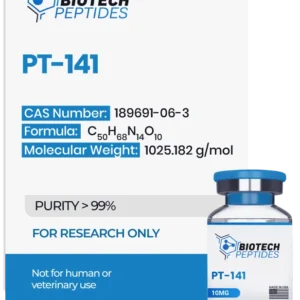
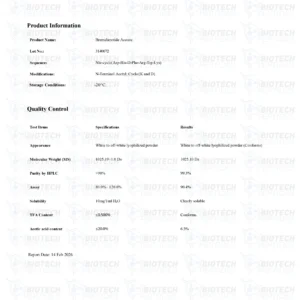
PT-141 (Bremelanotide) (10mg) is offered by Biotech Peptides for laboratory and analytical research. Also called bremelanotide, this synthetic cyclic heptapeptide is a melanocortin receptor agonist studied in relation to MC1R, MC3R, and MC4R signaling.accessdata.fda+2
-
Product: PT-141 (Bremelanotide)
-
Alternative name: Bremelanotide
-
Listed quantity: 10 mg
-
Reference molecular formula: C₅₀H₆₈N₁₄O₁₀
-
Intended use: Laboratory and analytical research only
Review the manufacturer specifications and applicable analytical documentation before selecting material for your protocol.
For research use only. Not for human consumption.


TB-500 (Thymosin Beta-4) (10mg)
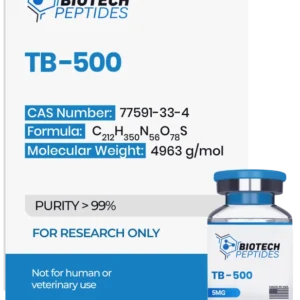
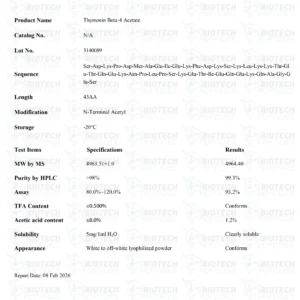
TB-500 (Thymosin Beta-4) (10mg) is offered by Biotech Peptides for laboratory and analytical research. TB-500 is a synthetic 43-residue peptide derived from thymosin beta-4, studied in relation to cell migration, angiogenesis, and wound-repair signaling. 1153
-
Product: TB-500
-
Full name: Thymosin Beta-4
-
Listed quantity: 10 mg
-
Reference molecular formula: C₂₁₂H₃₅₀N₅₆O₇₈S
-
Intended use: Laboratory and analytical research only
Review the manufacturer specifications and applicable analytical documentation before selecting material for your protocol.
For research use only. Not for human consumption.
TB-500 (Thymosin Beta-4) (5mg)
TB-500 (Thymosin Beta-4) (5mg) is offered by Biotech Peptides for laboratory and analytical research. TB-500 is a synthetic 43-residue peptide derived from thymosin beta-4, studied in relation to cell migration, angiogenesis, and wound-repair signaling. 1110
-
Product: TB-500
-
Full name: Thymosin Beta-4
-
Listed quantity: 5 mg
-
Reference molecular formula: C₂₁₂H₃₅₀N₅₆O₇₈S
-
Intended use: Laboratory and analytical research only
Review the manufacturer specifications and applicable analytical documentation before selecting material for your protocol.
For research use only. Not for human consumption.