


Acetyl Hexapeptide-3 (Argireline) (200mg)
$210.00
Acetyl Hexapeptide-3 (Argireline) (200mg), also known as Acetyl Hexapeptide-8, is a synthetic six-amino-acid peptide based on a segment of synaptosomal-associated protein 25 (SNAP-25).
Its research background includes investigations into SNARE-complex formation, calcium-dependent exocytosis and neurotransmitter release.
Product information:
- Product: Acetyl Hexapeptide-3 (Argireline)
- Listed quantity: 200mg
- Alternative name: Acetyl Hexapeptide-8
- Sequence: Ac-Glu-Glu-Met-Gln-Arg-Arg-NH₂
- CAS number: 616204-22-9
- Research area: SNAP-25 and SNARE-complex interactions
Explore our research peptides for sale at Biotech Peptides.
For laboratory and analytical research only. Not for human or animal consumption, personal administration, medical treatment, diagnosis, or veterinary application.
Acetyl Hexapeptide-3 (Argireline) (200mg)
Acetyl Hexapeptide-3 (Argireline) (200mg), also known as Acetyl Hexapeptide-8, is a synthetic hexapeptide based on a segment of synaptosomal-associated protein 25 (SNAP-25). Its amino-acid sequence is Ac-Glu-Glu-Met-Gln-Arg-Arg-NH₂.
Argireline has been investigated in biochemical research involving the SNARE protein complex, calcium-dependent exocytosis and neurotransmitter release. Published studies include laboratory investigations of peptide–protein interactions and experimental research involving topical formulations.
Listed by Biotech Peptides for laboratory and analytical research, this compound is relevant to investigations of peptide structure and cellular vesicle-fusion mechanisms.
What Is Acetyl Hexapeptide-3 (Argireline)?
Acetyl Hexapeptide-3 is an alternative technical name for Acetyl Hexapeptide-8, commonly associated with the research and cosmetic ingredient name Argireline.
The compound is a synthetic six-amino-acid peptide based on a segment of SNAP-25, a protein involved in the formation of the SNARE complex.
SNAP-25 participates in the molecular machinery responsible for vesicle fusion with cell membranes. This process is essential for regulated neurotransmitter release in nerve cells.
Argireline has been investigated for its ability to interfere with the formation or stability of the SNARE protein complex under experimental conditions.
Its structure makes it relevant to research involving:
- SNAP-25 protein interactions.
- SNARE-complex formation.
- Calcium-dependent exocytosis.
- Vesicle docking and membrane fusion.
- Peptide structure and biological signalling.
These research areas describe experimental mechanisms and should not be interpreted as evidence that the isolated research material produces a particular physiological or cosmetic outcome.
Acetyl Hexapeptide-3 and SNAP-25 Research
SNAP-25 is a component of the SNARE machinery involved in the release of neurotransmitters from nerve cells.
During calcium-dependent exocytosis, specialised proteins work together to facilitate the fusion of intracellular vesicles with the cell membrane. SNAP-25 contributes to this process by participating in the formation of the SNARE complex.
Argireline was designed using a segment of the SNAP-25 protein. Researchers have investigated whether this synthetic peptide can interfere with the protein interactions required for vesicle fusion.
A key publication in this research area is the 2002 study by Blanes-Mira and colleagues, published in the International Journal of Cosmetic Science.
The researchers investigated Ac-EEMQRR-NH₂ and reported that the peptide interfered with the formation or stability of the protein complex involved in calcium-dependent exocytosis.
The study provided an experimental basis for further investigations into Argireline, SNAP-25 and SNARE-associated mechanisms.
Importantly, these biochemical findings should not be interpreted as establishing that Argireline has the same mechanism, potency or effects as botulinum neurotoxins.
Scientific reference: Blanes-Mira et al. (2002) – A synthetic hexapeptide (Argireline) with antiwrinkle activity.
Research on Argireline and Topical Formulations
Published research has also investigated Argireline in topical formulations and examined associated skin-surface measurements.
In the 2002 study, researchers evaluated an oil-in-water emulsion containing 10% Argireline in healthy female volunteers. Skin topography measurements indicated a reduction in wrinkle depth of up to 30% following 30 days of treatment.
The study also investigated the peptide’s interaction with the SNARE complex.
These findings relate to a specific formulated preparation and experimental conditions. They do not establish equivalent results for an isolated 200mg research material or other formulations.
The distinction between a formulated preparation and a standalone peptide is important when interpreting cosmetic research.
Scientific reference: Blanes-Mira et al. (2002), International Journal of Cosmetic Science.
Human Research on Argireline
A 2013 randomised, placebo-controlled study published in the American Journal of Clinical Dermatology investigated the topical application of Argireline in 60 Chinese participants with peri-orbital wrinkles.
Participants were assigned to Argireline or placebo groups in a 3:1 ratio. The formulations were applied twice daily over four weeks.
The researchers evaluated changes in wrinkle appearance using subjective assessments and objective skin-surface measurements.
The Argireline group showed improvements in the reported subjective assessments and reductions in measured skin roughness compared with the placebo group.
This publication provides human research context for formulated topical Argireline. However, the results cannot be used to establish the effectiveness of an isolated research peptide, predict individual outcomes or confirm the characteristics of the material listed on this product page.
Scientific reference: Wang et al. (2013) – The anti-wrinkle efficacy of Argireline, a synthetic hexapeptide, in Chinese subjects.
Additional Experimental Research: Animal Models
Research has also examined Argireline in animal models to investigate changes in skin tissue structure.
A 2013 clinical and experimental publication included an investigation using aged mice induced by D-galactose. The researchers evaluated skin histology and collagen-fibre measurements following topical application.
The reported animal-model findings included changes in type I and type III collagen-fibre measurements.
These results should be interpreted within the context of the experimental model. Findings from animal studies cannot automatically be extrapolated to human outcomes or attributed to every preparation containing Argireline.
Scientific reference: The anti-wrinkle efficacy of synthetic hexapeptide (Argireline) in Chinese subjects.
Acetyl Hexapeptide-3 (Argireline) (200mg) – Reference Specifications
The following information summarises the reference characteristics associated with the recognised Argireline structure.
| Characteristic | Reference information |
|---|---|
| Product name | Acetyl Hexapeptide-3 (Argireline) |
| Listed quantity | 200mg |
| Alternative name | Acetyl Hexapeptide-8 |
| Common name | Argireline |
| Peptide length | 6 amino acids |
| Sequence | Ac-Glu-Glu-Met-Gln-Arg-Arg-NH₂ |
| CAS number | 616204-22-9 |
| Reference molecular formula | C₃₄H₆₀N₁₄O₁₂S |
| Reference molecular weight | Approximately 889.0 g/mol |
| Research area | SNAP-25 and SNARE-complex interactions |
Understanding the Peptide Structure
The sequence Ac-Glu-Glu-Met-Gln-Arg-Arg-NH₂ represents the chemical structure of the acetylated hexapeptide.
Its main structural features include:
- N-terminal acetylation: An acetyl group is attached to the beginning of the peptide sequence.
- Six amino acids: The sequence contains two glutamic acid residues, one methionine, one glutamine and two arginine residues.
- C-terminal amidation: The terminal group is represented by NH₂.
These structural features are important when identifying the compound and distinguishing it from other synthetic peptides.
The molecular formula and molecular weight shown above correspond to the PubChem reference record for Argireline acetate. The precise salt or counterion form of the material supplied in this product must be confirmed independently.
The listed 200mg quantity represents the stated product listing quantity, not an independently verified analytical assay.
Chemical reference: PubChem – Argireline acetate, CID 11228338.
Buy Acetyl Hexapeptide-3 (Argireline) from Biotech Peptides
Biotech Peptides lists Acetyl Hexapeptide-3 (Argireline) (200mg) within its research peptide collection.
Researchers looking to buy peptides can review the listed product information, recognised chemical characteristics and available batch documentation when comparing research materials.
Our research peptides for sale include additional compounds for laboratory and analytical research.
When comparing cheap peptides and other research materials from different suppliers, it is important to consider chemical identity, available analytical documentation and the stated product specifications. Price alone does not establish purity, identity or analytical quality.
For further information, you can also review our shipping policy and Research Use Only notice.
Documentation and Batch Verification
Chemical reference information helps describe a recognised compound, but it does not independently establish the characteristics of an individual product batch.
For batch-specific identity, purity and analytical information, consult the documentation associated with the relevant lot.
Where available, a Certificate of Analysis (COA) and supporting analytical results may provide information about:
- Product and batch identification.
- Analytical methods used.
- Reported analytical results.
- Measured purity or assay information, where available.
A batch-specific COA should be interpreted according to the tests and results actually reported. General compound specifications should not be substituted for analytical evidence relating to the supplied material.
Frequently Asked Questions
What is Acetyl Hexapeptide-3?
Acetyl Hexapeptide-3 is a synthetic six-amino-acid peptide also known as Acetyl Hexapeptide-8 or Argireline. It is based on a segment of the SNAP-25 protein.
Is Acetyl Hexapeptide-3 the same as Argireline?
Acetyl Hexapeptide-3 is a recognised alternative name for the peptide commonly known as Argireline. Acetyl Hexapeptide-8 is another widely used technical name for the same reference peptide structure.
What is the sequence of Argireline?
The reference sequence is Ac-Glu-Glu-Met-Gln-Arg-Arg-NH₂. It contains six amino acids, an N-terminal acetyl group and a C-terminal amide.
What is the molecular weight of Acetyl Hexapeptide-3?
The reference molecular weight is approximately 889.0 g/mol for the Argireline acetate reference entry. The precise molecular weight applicable to a particular salt or counterion form depends on its chemical composition.
What is the relationship between Argireline and SNAP-25?
Argireline is a synthetic peptide based on a segment of SNAP-25. Research has investigated its interaction with the SNARE protein complex, which participates in vesicle fusion and neurotransmitter release.
What scientific research has been conducted on Argireline?
Published research includes biochemical investigations of SNARE-complex interactions, studies of topical formulations in human participants and experimental investigations using animal models.
The findings should be interpreted according to the specific formulation, experimental design and research model.
Is batch-specific documentation available?
The availability of batch-specific documentation should be confirmed for the relevant product lot. Where a Certificate of Analysis is available, it can provide additional information about the analytical characteristics reported for that batch.
Research Use Only
Acetyl Hexapeptide-3 (Argireline) (200mg) is listed by Biotech Peptides for laboratory and analytical research purposes.
For laboratory and analytical research only. Not for human or animal consumption, personal administration, medical treatment, diagnosis, or veterinary application.
Researchers should review the relevant product information, available documentation and applicable handling requirements before selecting any material for laboratory work.
| Brand | Biotech Peptides |
|---|
Related products
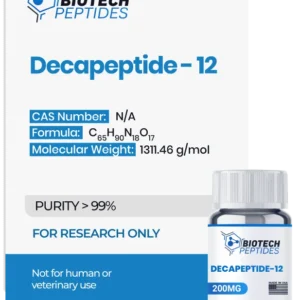
Decapeptide-12 (200mg)
Decapeptide-12 (200mg), also known by its sequence YRSRKYSSWY, is a synthetic ten-amino-acid peptide investigated for its interaction with tyrosinase and its role in experimental melanogenesis research. Published studies have examined its effects on tyrosinase activity and melanin content in laboratory models. Listed for laboratory and analytical research.
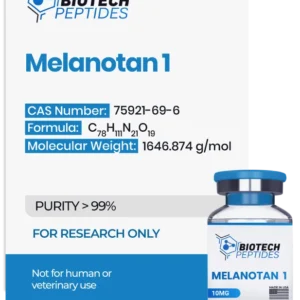
Melanotan 1 (10mg)
Melanotan 1 (10mg) is offered by Biotech Peptides for laboratory and analytical research. Also called afamelanotide, this synthetic 13-residue analogue of alpha-melanocyte-stimulating hormone has been studied in relation to melanocortin receptor signaling and melanin production.pmc.ncbi.nlm.nih+1
-
Product: Melanotan 1
-
Alternative name: Afamelanotide
-
Listed quantity: 10 mg
-
Reference molecular formula: C₇₈H₁₁₁N₂₁O₁₉
-
Intended use: Laboratory and analytical research only
Review the manufacturer specifications and applicable analytical documentation before selecting material for your protocol.
For research use only. Not for human consumption.


Pal-AHK (200mg) | Biotech Peptides
Pal-AHK (200mg) is listed as a palmitoylated AHK tripeptide for laboratory and analytical research. The supplied product description identifies the proposed structure as palmitoyl-Ala-His-Lys, combining an alanine-histidine-lysine peptide sequence with an N-terminal palmitoyl group.
Proposed reference characteristics (subject to manufacturer confirmation):- Listed quantity: 200mg
- Proposed peptide sequence: Ala-His-Lys (AHK)
- Proposed modification: N-terminal palmitoyl group
- Proposed molecular formula: C₃₁H₅₆N₆O₅
- Proposed molecular weight: Approximately 592.8 g/mol


Semax (25mg)
Semax (25mg) is offered by Biotech Peptides for laboratory and analytical research. Semax is a synthetic heptapeptide analogue of ACTH(4-10) studied in relation to neurotrophin gene expression and ischemic injury models. 1041
-
Product: Semax
-
Full name: ACTH(4-7)-Pro-Gly-Pro
-
Listed quantity: 25 mg
-
Reference molecular formula: C₃₉H₅₄N₁₀O₁₀S
-
Intended use: Laboratory and analytical research only
Review the manufacturer specifications and applicable analytical documentation before selecting material for your protocol.
For research use only. Not for human consumption.
TB-500 (Thymosin Beta-4) (5mg)
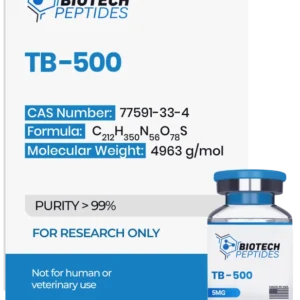
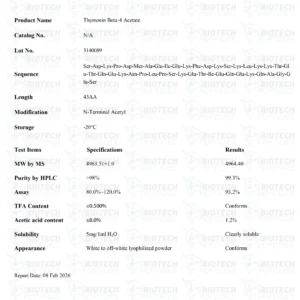
TB-500 (Thymosin Beta-4) (5mg) is offered by Biotech Peptides for laboratory and analytical research. TB-500 is a synthetic 43-residue peptide derived from thymosin beta-4, studied in relation to cell migration, angiogenesis, and wound-repair signaling. 1110
-
Product: TB-500
-
Full name: Thymosin Beta-4
-
Listed quantity: 5 mg
-
Reference molecular formula: C₂₁₂H₃₅₀N₅₆O₇₈S
-
Intended use: Laboratory and analytical research only
Review the manufacturer specifications and applicable analytical documentation before selecting material for your protocol.
For research use only. Not for human consumption.


Tesamorelin (5mg & 10mg)
Tesamorelin (5mg & 10mg) is offered by Biotech Peptides for laboratory and analytical research. Tesamorelin is a synthetic 44-residue GHRH analogue studied in relation to growth hormone secretion, visceral adiposity, and metabolic signaling. 1137
-
Product: Tesamorelin
-
Full name: N-(trans-3-hexenoyl)-[Tyr1]-hGRF(1-44)-NH2 acetate
-
Listed quantities: 5 mg and 10 mg
-
Reference molecular formula: C₂₂₁H₃₆₆N₇₂O₆₇S
-
Intended use: Laboratory and analytical research only
Review the manufacturer specifications and applicable analytical documentation before selecting material for your protocol.
For research use only. Not for human consumption.
Thymosin Alpha-1 (10mg)
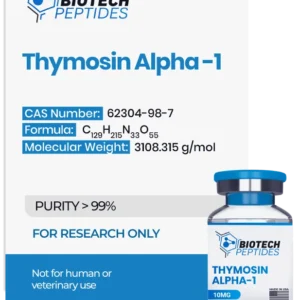
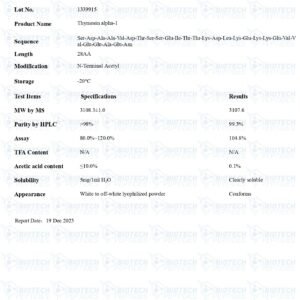
Thymosin Alpha-1 (10mg) is offered by Biotech Peptides for laboratory and analytical research. Thymosin Alpha-1 is a synthetic 28-residue peptide, also called thymalfasin, studied in relation to immune modulation, toll-like receptor signaling, and antiviral research. 1213
-
Product: Thymosin Alpha-1
-
Alternative name: Thymalfasin
-
Listed quantity: 10 mg
-
Reference molecular formula: C₁₂₉H₂₁₅N₃₃O₅₅
-
Intended use: Laboratory and analytical research only
Review the manufacturer specifications and applicable analytical documentation before selecting material for your protocol.
For research use only. Not for human consumption.