

GHK Basic Tripeptide-1 (200mg) | Biotech Peptides
$165.00
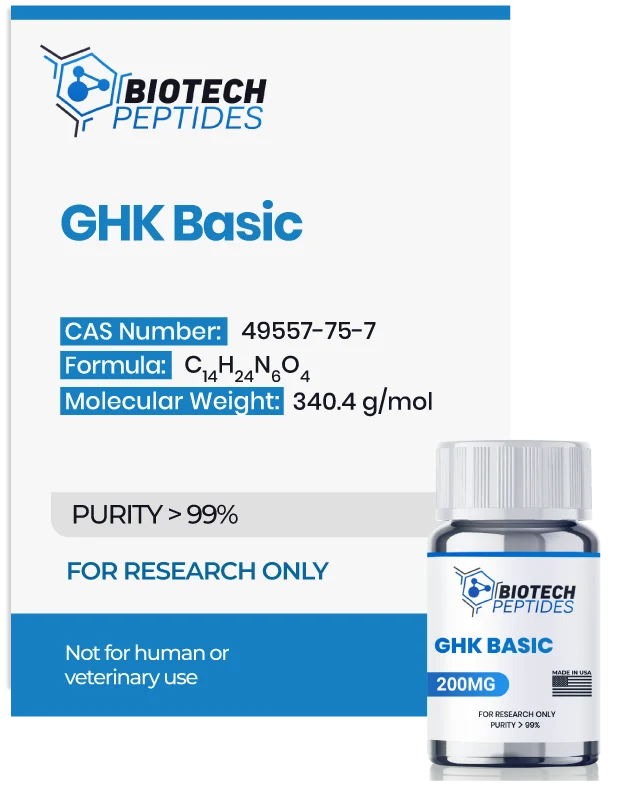
GHK Basic Tripeptide-1 (200mg) is a synthetic, copper-free tripeptide consisting of glycyl-L-histidyl-L-lysine (Gly-His-Lys). Also known as GHK or Tripeptide-1, it is structurally distinct from the copper-associated compound GHK-Cu.
Its research background includes investigations into peptide chemistry, extracellular-matrix biology and cellular interactions. Biotech Peptides lists this compound for laboratory and analytical research.
Product information:
- Product: GHK Basic (Tripeptide-1)
- Listed quantity: 200mg
- Peptide sequence: Gly-His-Lys
- Molecular formula: C₁₄H₂₄N₆O₄
- Molecular weight: Approximately 340.38 g/mol
- CAS number: 49557-75-7
- Chemical form: Copper-free GHK reference structure
Explore our research peptides for sale for additional laboratory research materials.
For laboratory and analytical research only. Not for human or animal consumption, personal administration, medical treatment, diagnosis, or veterinary application.
GHK Basic Tripeptide-1 (200mg) – Copper-Free GHK Peptide
GHK Basic Tripeptide-1 (200mg) is a synthetic, copper-free tripeptide consisting of glycyl-L-histidyl-L-lysine, commonly abbreviated as GHK. Also known as Tripeptide-1 or Gly-His-Lys, this three-amino-acid peptide is structurally distinct from its copper-associated counterpart, GHK-Cu.
GHK has been investigated in biochemical research involving peptide interactions, cellular signalling and extracellular-matrix biology. Its chemical structure and relationship with copper make it relevant to research examining the differences between free tripeptides and metal-associated peptide complexes.
Listed by Biotech Peptides for laboratory and analytical research, GHK Basic provides a reference compound for investigations involving copper-free GHK and related peptide chemistry.
What Is GHK Basic Tripeptide-1?
GHK Basic is the copper-free form of glycyl-L-histidyl-L-lysine, a naturally occurring tripeptide identified in biological research.
The name GHK represents its three constituent amino acids:
- Glycine (Gly)
- Histidine (His)
- Lysine (Lys)
Together, these amino acids form a short peptide sequence commonly written as Gly-His-Lys.
GHK has also been studied in connection with copper binding. Histidine contains an imidazole side chain that can participate in metal coordination, making GHK relevant to research involving peptide–metal interactions.
However, the copper-free peptide and its copper-associated complex represent different chemical forms. Their molecular composition, reference specifications and experimental research findings should be considered separately.
GHK Basic vs GHK-Cu: Understanding the Difference
An important distinction when researching GHK is the difference between the free tripeptide and its copper-associated form.
GHK Basic (copper-free GHK) consists of the Gly-His-Lys peptide sequence without a copper ion as part of the compound’s defined reference structure.
GHK-Cu (copper peptide) refers to a copper-associated complex involving the same underlying tripeptide sequence.
Although both compounds share the Gly-His-Lys sequence, their chemical identities differ.
| Characteristic | GHK Basic | GHK-Cu |
|---|---|---|
| Peptide sequence | Gly-His-Lys | Gly-His-Lys |
| Copper association | No copper in the reference structure | Copper-associated complex |
| Molecular formula | C₁₄H₂₄N₆O₄ | Depends on the defined copper-complex representation |
| Reference molecular weight | Approximately 340.38 g/mol | Depends on the copper complex and salt form |
| Chemical identity | Free tripeptide | Copper-associated peptide complex |
This distinction is important when reviewing scientific publications, chemical databases and product documentation.
Research involving GHK-Cu should not automatically be presented as direct evidence for copper-free GHK.
Scientific Research: GHK and Extracellular-Matrix Biology
GHK has appeared in scientific investigations involving extracellular-matrix proteins and cellular processes.
The extracellular matrix (ECM) is a network of proteins and other molecules surrounding cells. It provides structural support and participates in cellular communication and tissue organisation.
Fibroblasts are among the cell types involved in extracellular-matrix research. They produce and organise structural components, including collagen and other matrix-associated proteins.
GHK and GHK-Cu have both been discussed in the wider literature concerning these biological processes. However, the exact compound used in an experiment is essential when interpreting its findings.
For example, studies involving copper-associated GHK cannot automatically establish equivalent activity for the free tripeptide.
Experimental Research: GHK and GHK-Cu in Fibroblast Models
A particularly relevant study published in 2000 in Life Sciences investigated the effects of the glycyl-L-histidyl-L-lysine copper complex on matrix metalloproteinase-2 (MMP-2) expression in cultured dermal fibroblasts.
The researchers compared the copper-associated complex with the individual components under experimental conditions.
The study reported that GHK-Cu increased MMP-2 levels in conditioned media from cultured fibroblasts. The effect was also reproduced by copper ions, but not by the GHK tripeptide alone.
This distinction is especially important for research involving GHK Basic.
It demonstrates why findings associated with the copper complex should not automatically be attributed to the copper-free peptide. The experimental results depended on the chemical form being investigated.
Scientific reference: Siméon et al. (2000) – The tripeptide-copper complex stimulates matrix metalloproteinase-2 expression by fibroblast cultures.
GHK and Peptide–Metal Interaction Research
GHK is of interest in peptide chemistry because its amino-acid composition includes groups capable of participating in metal coordination.
Histidine contains an imidazole ring, while the peptide backbone also provides potential coordination sites. These structural features are relevant to investigations involving peptide–metal interactions.
Copper-associated GHK is one example of a peptide–metal complex.
When comparing copper-free GHK with GHK-Cu, researchers should consider the following:
- The presence or absence of copper in the defined chemical structure.
- The molecular formula and molecular weight of the specific compound.
- The counterion or salt form, where applicable.
- Whether the experimental material was free GHK or a copper-associated complex.
- Whether the reported results were obtained using the same chemical form.
These considerations help maintain accurate compound identification and scientific interpretation.
GHK Basic Tripeptide-1 (200mg) – Reference Specifications
The following table summarises the recognised reference characteristics of copper-free glycyl-L-histidyl-L-lysine.
| Characteristic | Reference information |
|---|---|
| Product name | GHK Basic (Tripeptide-1) |
| Listed quantity | 200mg |
| Chemical name | Glycyl-L-histidyl-L-lysine |
| Alternative names | GHK, Gly-His-Lys, Tripeptide-1 |
| Peptide length | 3 amino acids |
| Sequence | Gly-His-Lys |
| Molecular formula | C₁₄H₂₄N₆O₄ |
| Molecular weight | Approximately 340.38 g/mol |
| CAS number | 49557-75-7 |
| PubChem CID | 73587 |
| Chemical form | Copper-free reference structure |
Understanding the GHK Chemical Structure
The GHK sequence consists of three amino acids connected through peptide bonds.
Its structure contains:
- An N-terminal glycine residue.
- An L-histidine residue containing an imidazole side chain.
- An L-lysine residue with an amino-containing side chain.
- A C-terminal carboxylic acid group.
The reference molecular formula and molecular weight describe the copper-free GHK structure.
These values are chemical database references, not batch-specific analytical results. They do not independently establish the identity, purity, salt form or measured peptide content of the supplied product.
The listed 200mg quantity represents the product’s stated listing quantity and should not be interpreted as an independently verified assay result.
Chemical reference: PubChem – Glycyl-L-histidyl-L-lysine, CID 73587.
Buy GHK Basic Tripeptide-1 from Biotech Peptides
Biotech Peptides lists GHK Basic Tripeptide-1 (200mg) within its research peptide collection.
Researchers looking to buy peptides can review the listed compound identity, reference chemical specifications and available product documentation when comparing laboratory materials.
Our research peptides for sale include additional compounds for laboratory and analytical research.
When comparing cheap peptides or other research materials from different suppliers, consider the available chemical specifications and batch-specific analytical documentation. A lower listed price does not establish the identity, purity or analytical quality of a product.
For additional information, you can also review our shipping policy and Research Use Only notice.
Documentation and Batch Verification
Reference chemical information helps identify a recognised compound, but it does not independently confirm the characteristics of an individual product batch.
For product-specific identity, purity and analytical information, consult the documentation associated with the relevant lot.
Where available, a Certificate of Analysis (COA) and supporting analytical results may provide information such as:
- Product and batch identification.
- Analytical methods used.
- Reported analytical results.
- Measured purity or assay information, where available.
For GHK Basic, particular attention should be given to the distinction between copper-free GHK and copper-associated material when reviewing analytical documentation.
A COA should be interpreted according to the tests and results actually reported.
Frequently Asked Questions
What is GHK Basic Tripeptide-1?
GHK Basic is a copper-free tripeptide consisting of glycyl-L-histidyl-L-lysine. It is also known as GHK, Gly-His-Lys and Tripeptide-1.
Is GHK Basic the same as GHK-Cu?
No. GHK Basic is the copper-free tripeptide, while GHK-Cu is a copper-associated complex involving the same underlying peptide sequence. They are chemically distinct forms.
What is the sequence of GHK Basic?
The reference amino-acid sequence is Gly-His-Lys, consisting of glycine, L-histidine and L-lysine.
What is the molecular weight of GHK Basic?
The reference molecular weight of copper-free GHK is approximately 340.38 g/mol, according to PubChem.
What is the difference between GHK and Tripeptide-1?
GHK is the abbreviation for glycyl-L-histidyl-L-lysine. Tripeptide-1 is another name used for this three-amino-acid peptide in cosmetic ingredient nomenclature.
What research has been conducted on GHK?
GHK has been discussed in biochemical and peptide research involving cellular interactions, extracellular-matrix biology and copper coordination.
Some widely cited fibroblast and extracellular-matrix studies specifically investigated GHK-Cu rather than free GHK. These findings should be attributed to the compound actually tested.
Is batch-specific documentation available?
The availability of batch-specific documentation should be confirmed for the relevant product lot. Where a Certificate of Analysis is available, it can provide additional information about the analytical characteristics reported for that batch.
Research Use Only
GHK Basic Tripeptide-1 (200mg) is listed by Biotech Peptides for laboratory and analytical research purposes.
For laboratory and analytical research only. Not for human or animal consumption, personal administration, medical treatment, diagnosis, or veterinary application.
Researchers should review the relevant product information, available documentation and applicable handling requirements before selecting any material for laboratory work.
| Brand | Biotech Peptides |
|---|
Related products
FOXO4-DRI (Proxofim) (10mg)
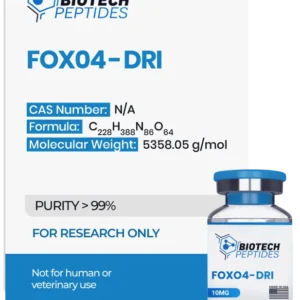
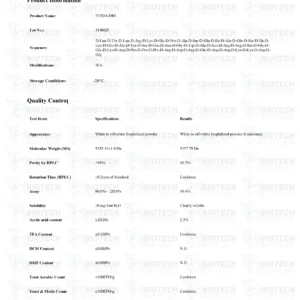
FOXO4-DRI (Proxofim) (10mg) is offered by Biotech Peptides for laboratory and analytical research. FOXO4-DRI is a synthetic D-retro-inverso peptide, also called Proxofim, studied in relation to FOXO4-p53 signaling and senescent-cell apoptosis. 1241
-
Product: FOXO4-DRI
-
Alternative name: Proxofim
-
Listed quantity: 10 mg
-
Reference molecular formula: C₂₂₈H₃₈₈N₈₆O₆₄
-
Intended use: Laboratory and analytical research only
Review the manufacturer specifications and applicable analytical documentation before selecting material for your protocol.
For research use only. Not for human consumption.
Mod GRF 1-29 (CJC-1295 NO DAC) (5mg)
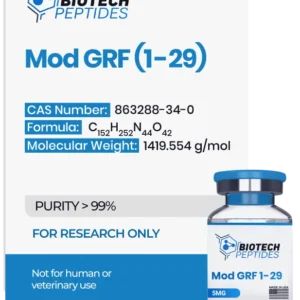
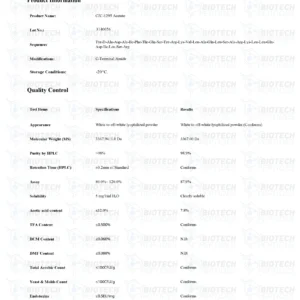
Mod GRF 1-29 (CJC-1295 NO DAC) (5mg) is offered by Biotech Peptides for laboratory and analytical research. Mod GRF 1-29 is a synthetic 29-residue GHRH analogue studied in relation to growth hormone-releasing hormone receptor signaling and somatotroph cell function. 1056
-
Product: Mod GRF 1-29
-
Alternative name: CJC-1295 without DAC
-
Listed quantity: 5 mg
-
Reference molecular formula: C₁₅₂H₂₅₂N₄₄O₄₂
-
Intended use: Laboratory and analytical research only
Review the manufacturer specifications and applicable analytical documentation before selecting material for your protocol.
For research use only. Not for human consumption.
Nonapeptide-1 (200mg)
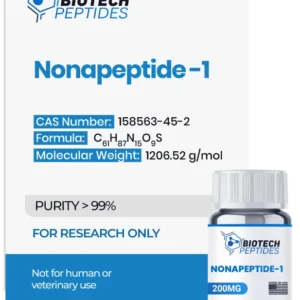
- Product: Nonapeptide-1
- Alternative name: Melanostatine-5
- Listed quantity: 200mg
- Peptide length: 9 amino acids
- Reference sequence: Met-Pro-D-Phe-Arg-D-Trp-Phe-Lys-Pro-Val-NH₂
- CAS number: 158563-45-2


Pal-AHK (200mg) | Biotech Peptides
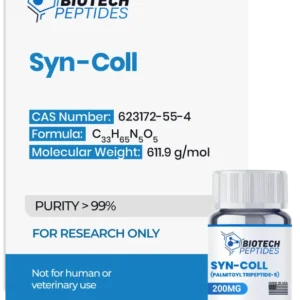
Pal-AHK (200mg) is listed as a palmitoylated AHK tripeptide for laboratory and analytical research. The supplied product description identifies the proposed structure as palmitoyl-Ala-His-Lys, combining an alanine-histidine-lysine peptide sequence with an N-terminal palmitoyl group.
Proposed reference characteristics (subject to manufacturer confirmation):- Listed quantity: 200mg
- Proposed peptide sequence: Ala-His-Lys (AHK)
- Proposed modification: N-terminal palmitoyl group
- Proposed molecular formula: C₃₁H₅₆N₆O₅
- Proposed molecular weight: Approximately 592.8 g/mol


Tesamorelin (5mg & 10mg)
Tesamorelin (5mg & 10mg) is offered by Biotech Peptides for laboratory and analytical research. Tesamorelin is a synthetic 44-residue GHRH analogue studied in relation to growth hormone secretion, visceral adiposity, and metabolic signaling. 1137
-
Product: Tesamorelin
-
Full name: N-(trans-3-hexenoyl)-[Tyr1]-hGRF(1-44)-NH2 acetate
-
Listed quantities: 5 mg and 10 mg
-
Reference molecular formula: C₂₂₁H₃₆₆N₇₂O₆₇S
-
Intended use: Laboratory and analytical research only
Review the manufacturer specifications and applicable analytical documentation before selecting material for your protocol.
For research use only. Not for human consumption.
Thymalin (25mg)
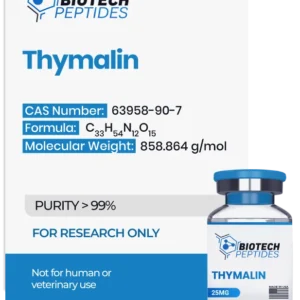
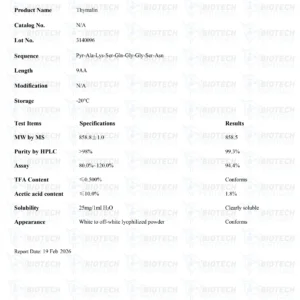
Thymalin (25mg) is offered by Biotech Peptides for laboratory and analytical research. Thymalin is a synthetic 9-residue peptide, also called thymulin, studied in relation to immune modulation, cytokine signaling, and neuroendocrine pathways. 1226
-
Product: Thymalin
-
Alternative name: Thymulin
-
Listed quantity: 25 mg
-
Reference molecular formula: C₃₃H₅₄N₁₂O₁₅
-
Intended use: Laboratory and analytical research only
Review the manufacturer specifications and applicable analytical documentation before selecting material for your protocol.
For research use only. Not for human consumption.
