

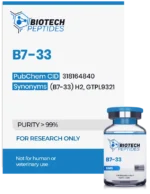
B7-33 (6mg)
$62.00
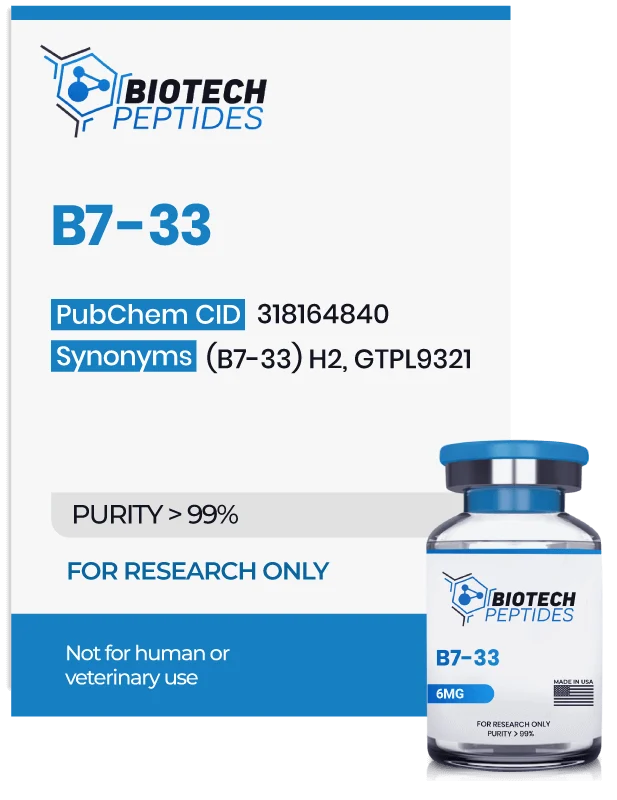
B7-33 (6mg) is offered by Biotech Peptides for laboratory and analytical research. B7-33 is a synthetic single-chain derivative of human relaxin-2 investigated for functionally selective signaling at the relaxin family peptide receptor 1, RXFP1.
-
Product: B7-33
-
Listed quantity: 6 mg
-
Reference sequence: VIKLSGRELVRAQIAISGMSTWSKRSL-NH₂
-
Reference peptide length: 27 amino acids
-
Intended use: Laboratory and analytical research only
Review the manufacturer specifications and applicable analytical documentation before selecting material for your protocol.
For research use only. Not for human consumption.
B7-33 (6mg) for Laboratory Research
B7-33 (6mg) is offered by Biotech Peptides for laboratories investigating relaxin-receptor signaling and extracellular-matrix regulation. B7-33 is a synthetic single-chain analogue derived from the B-chain of human relaxin-2, rather than the complete two-chain hormone.
For laboratories looking to buy B7-33, this listing identifies a 6 mg quantity. Confirm the supplied material’s sequence, terminal groups, chemical form, and analytical characteristics against the requirements of the intended work.
Explore our research peptides for sale to review other laboratory-use listings.
B7-33 Product Information
| Property | Listing information |
|---|---|
| Product name | B7-33 |
| Listed quantity | 6 mg |
| Intended application | Laboratory and analytical research |
| Documentation inquiries | Include the product name and batch identifier, where available |
The 6 mg designation describes the quantity stated for this listing. It does not independently establish net peptide content or confirm that a particular quantity-assay method has been performed.
Reference Structure and Sequence
The original development study describes B7-33 as a modified relaxin-2 B-chain derivative. The design removes six N-terminal residues from the B1–33 sequence and replaces two cysteine residues with serine. The resulting reference peptide is a linear, single-chain molecule rather than the disulfide-linked two-chain structure of native relaxin-2.
| Reference characteristic | Information |
|---|---|
| Reference sequence | VIKLSGRELVRAQIAISGMSTWSKRSL-NH₂ |
| Peptide length | 27 amino acids |
| Reference C-terminal group | Amide |
| Structural class | Single-chain relaxin-2 B-chain derivative |
| Principal research receptor | RXFP1 |
The original study synthesized its peptides as C-terminal amides. Confirm that the supplied commercial material matches this terminal specification before treating the research compound and product as equivalent.
B7-33 and RXFP1 Signaling
A foundational study by Hossain and colleagues investigated B7-33 in receptor-expression systems, fibroblast cultures, and rodent disease models. The researchers described it as a functionally selective RXFP1 agonist because its signaling profile depended on the pathway and cellular system examined.
In rat renal myofibroblasts expressing RXFP1 naturally, B7-33 strongly stimulated ERK1/2 phosphorylation and increased matrix metalloproteinase-2, or MMP-2. MMP-2 is an enzyme involved in extracellular-matrix turnover. Receptor-antagonist experiments supported involvement of RXFP1 and the angiotensin II type 2 receptor in the observed response.
Read the original study of B7-33 and functionally selective RXFP1 signaling for the experimental design and findings.
Understanding ERK and cAMP Responses
B7-33 should not be described as universally incapable of activating cAMP. The original study detected cAMP responses, although with substantially lower potency than human relaxin-2 in the tested systems. Its comparatively strong ERK1/2 and MMP-2 responses in fibroblasts contrasted with weaker activity in engineered receptor-expression systems.
This distinction matters when choosing an assay. Activity measured in one cell type or signaling pathway does not establish equivalent potency in another.
“Functionally selective” describes this experimental signaling profile. It does not mean that the compound is free of adverse effects or selectively beneficial in every biological setting.
Fibrosis and Cardiac-Remodeling Research
The original investigation evaluated B7-33 in rodent models involving cardiac and airway fibrosis. Researchers reported reductions in collagen-associated measurements and improvements in selected functional endpoints under the conditions studied.
A separate 2020 study examined B7-33 in mice subjected to cardiac ischemia–reperfusion injury and in isolated cardiac cells. Investigators reported reduced injury-associated measurements, preserved cardiac function, and changes in endoplasmic-reticulum stress markers. Experiments using an ERK-pathway inhibitor supported a role for that signaling pathway in certain cellular responses.
Read the primary study of B7-33 in cardiac ischemia–reperfusion models for the methods and limitations.
These are preclinical findings. They do not establish B7-33 as a treatment for heart disease, pulmonary fibrosis, scarring, or other human conditions.
Vascular Research
A study by Marshall and colleagues examined vascular responses in rat and mouse artery preparations. B7-33 enhanced bradykinin-mediated relaxation in rat mesenteric arteries, but did not produce the same overall relaxation effect in the small renal artery or aorta. This demonstrates that the observed response was vascular-bed dependent.
The study also investigated mouse mesenteric arteries exposed to placental trophoblast-conditioned media. Findings from that experimental preparation do not establish a treatment for preeclampsia or pregnancy-related complications.
Read the published vascular study summary for the experimental context.
Research Limitations
Studies of human relaxin-2, B7-33, and lipidated B7-33 derivatives should be distinguished. Structural changes can affect analytical characteristics and experimental behavior.
Likewise, a finding that B7-33 did not exacerbate tumor growth in one mouse model does not establish general cancer safety or anticancer activity. The original investigation assessed a specific prostate-tumor model over a defined experimental period.
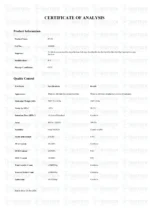
Published research does not verify the identity, purity, quantity, or biological activity of the commercial batch supplied with this listing.
Documentation and Batch Verification
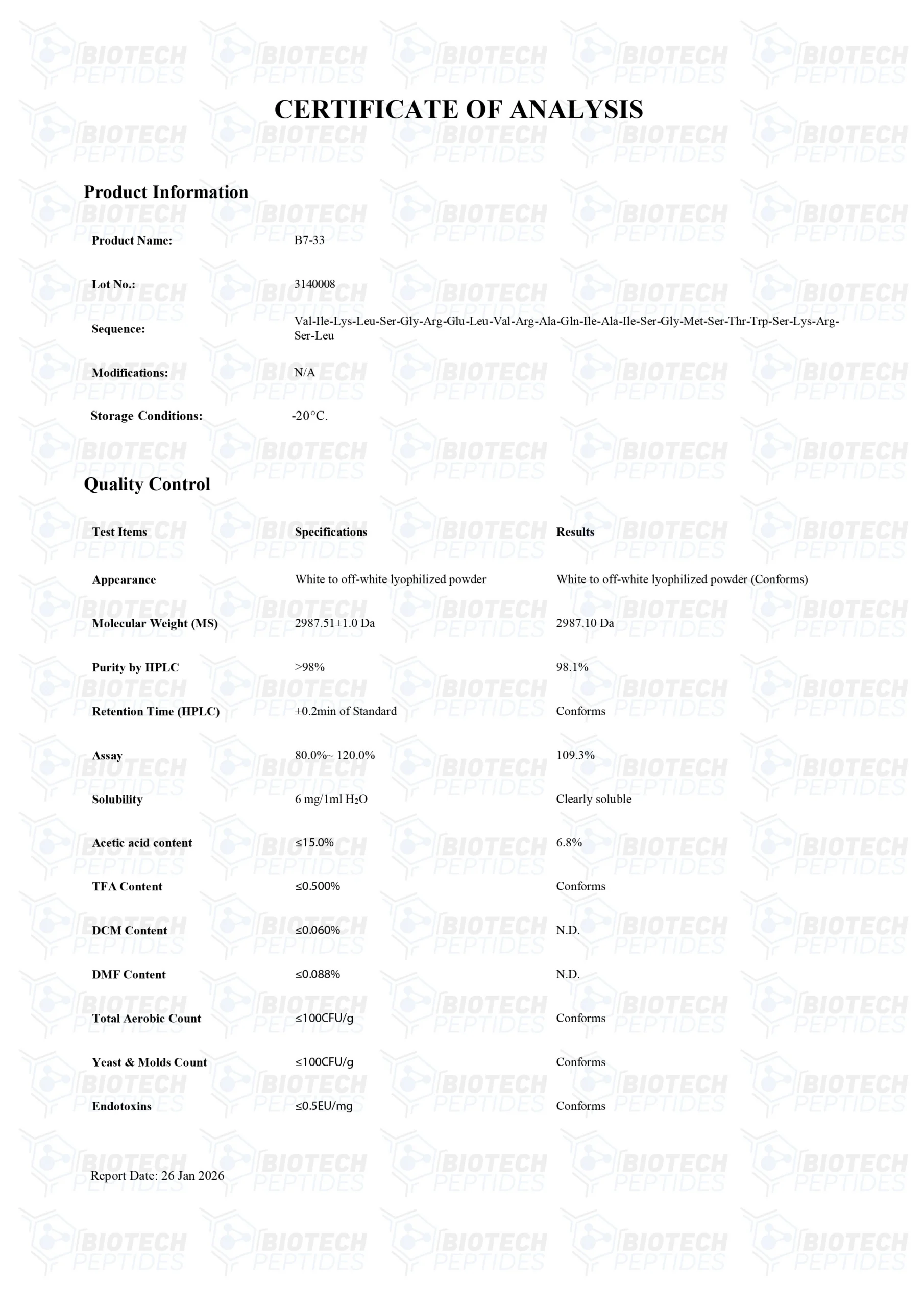
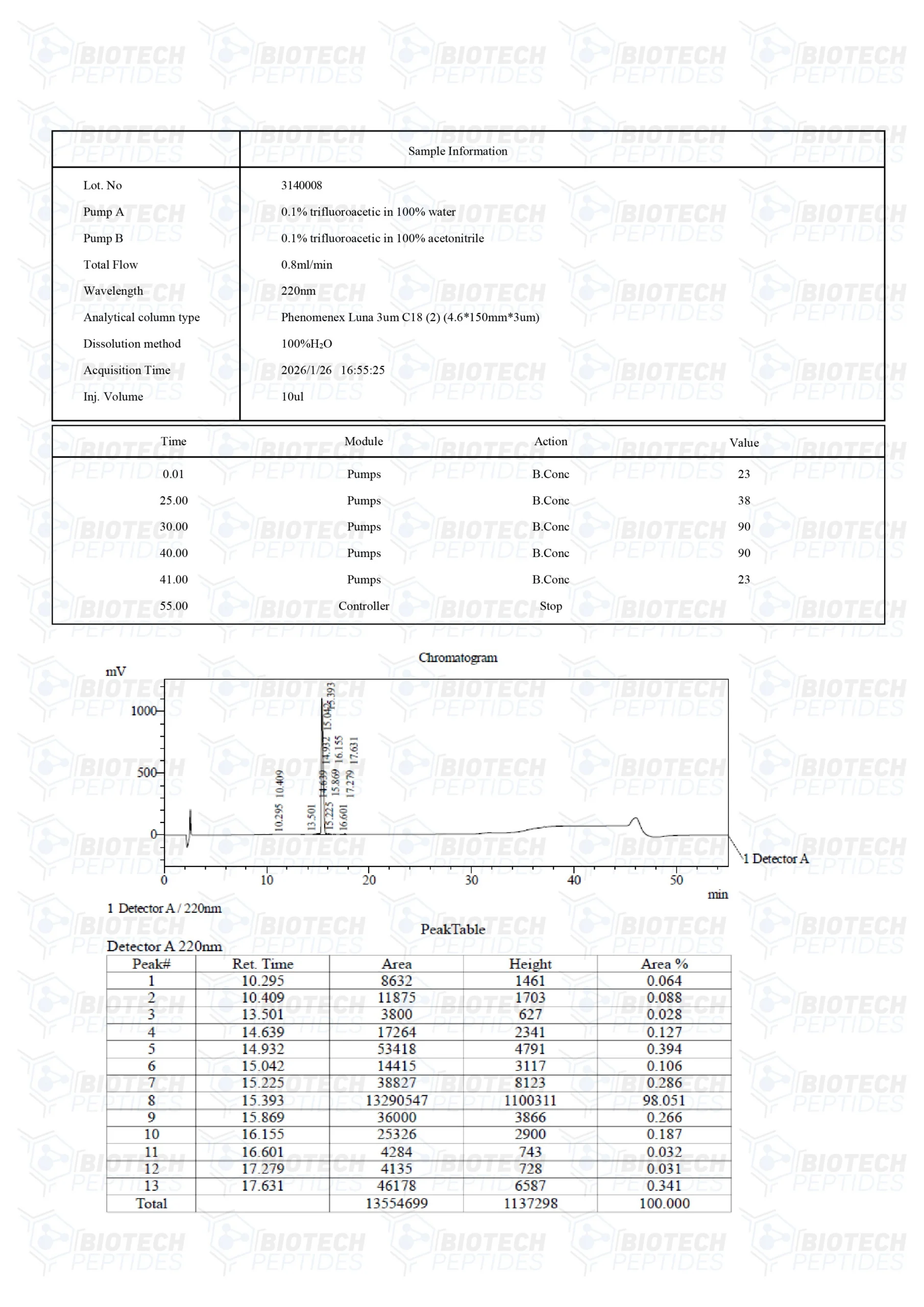
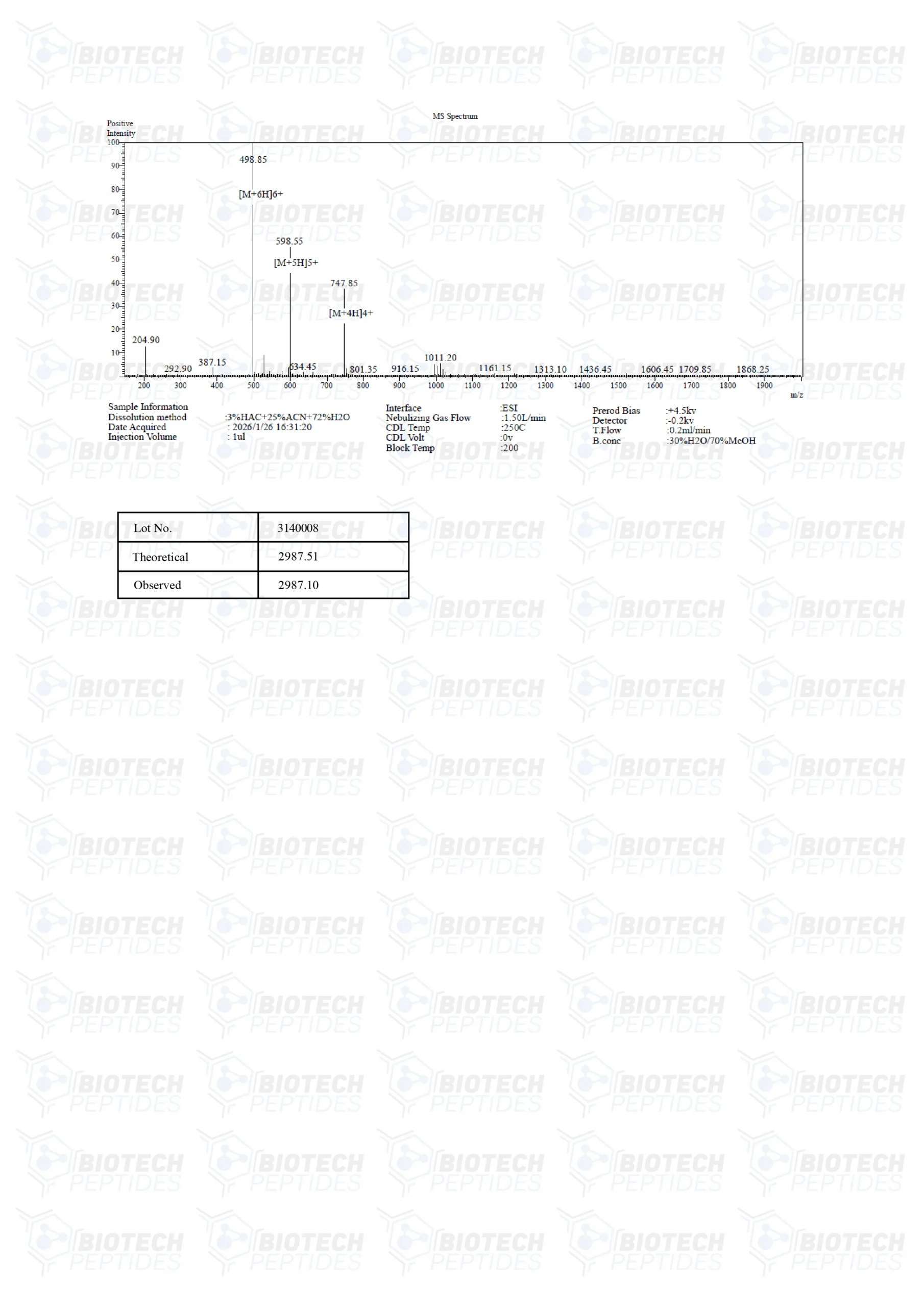
Before selecting B7-33 (6mg), review the documentation associated with the exact material being supplied. Relevant information may include:
-
Product name and batch or lot identifier.
-
Manufacturer specifications and chemical form.
-
Complete sequence and terminal-group information.
-
Confirmation of whether the material is unmodified or a derivative.
-
Counterion information, where applicable.
-
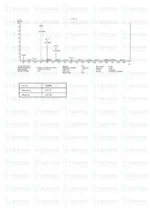
Identity-testing methods and reported results.
-
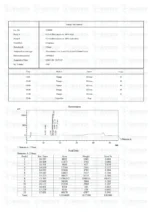
Purity-testing methods and supporting analytical data.
-
Quantity or peptide-content measurements, where required.
-
Product-specific storage and handling instructions.
Match identifiers across the label, specifications, and analytical reports. For inquiries, provide “B7-33 (6mg),” the batch number where available, and the specific information your laboratory requires.
Storage and Handling
Follow the product-specific instructions supplied with the material and your laboratory’s applicable procedures.
Do not transfer solubility claims, storage temperatures, shelf-life estimates, or preparation instructions from another supplier’s formulation or a modified B7-33 derivative. Obtain clarification if documented instructions are unavailable or unclear.
Frequently Asked Questions About B7-33 (6mg)
Is B7-33 the same as human relaxin-2?
No. B7-33 is a modified single-chain B-chain derivative. Native human relaxin-2 has two chains connected by disulfide bonds.
Does B7-33 completely avoid cAMP signaling?
No. The original study reported cAMP activity with lower potency than human relaxin-2. The preferential signaling profile depended on the cellular system and endpoint examined.
Does “functionally selective” mean clinically safe?
No. It describes comparative signaling behavior under experimental conditions, not established human safety.
What does the 6mg designation mean?
It is the quantity stated for this listing. It does not describe a concentration or independently establish net peptide content.
Does published research confirm this product’s activity?
No. Publications describe the material and conditions used by the investigators. Assess the supplied batch using relevant manufacturer specifications and analytical evidence.
Where can I find delivery information?
Review our shipping information for current order-processing and delivery terms.
Research Use Only
B7-33 (6mg) is sold for laboratory and analytical research only. Not for human or animal consumption, personal administration, medical treatment, diagnosis, or veterinary application.
Review our Research-Use-Only Policy before ordering.
| Brand | Biotech Peptides |
|---|
Related products


ACE-031 (1mg)
ACE-031 (1mg) is offered by Biotech Peptides for laboratory and analytical research. ACE-031 is a soluble fusion protein comprising the extracellular domain of activin receptor type IIB fused to the Fc portion of human IgG1, studied in relation to myostatin signaling and muscle-mass regulation. 1198
-
Product: ACE-031
-
Alternative name: Ramatercept
-
Listed quantity: 1 mg
-
Reference molecular weight: 77.24 kDa
-
Intended use: Laboratory and analytical research only
Review the manufacturer specifications and applicable analytical documentation before selecting material for your protocol.
For research use only. Not for human consumption.


ARA-290 (16mg)
ARA-290 (16mg) is offered by Biotech Peptides for laboratory and analytical research. Also called cibinetide, ARA-290 is a synthetic 11-residue peptide derived from the beta-helix domain of erythropoietin, studied in relation to innate repair receptor signaling and inflammatory pathways. 1181
-
Product: ARA-290
-
Alternative name: Cibinetide
-
Listed quantity: 16 mg
-
Reference molecular formula: C₅₁H₅₄N₁₆O₂₁
-
Intended use: Laboratory and analytical research only
Review the manufacturer specifications and applicable analytical documentation before selecting material for your protocol.
For research use only. Not for human consumption.
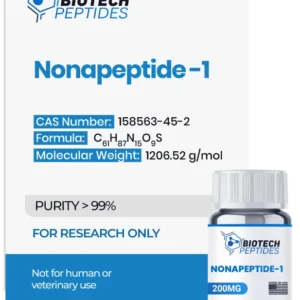
Nonapeptide-1 (200mg)
- Product: Nonapeptide-1
- Alternative name: Melanostatine-5
- Listed quantity: 200mg
- Peptide length: 9 amino acids
- Reference sequence: Met-Pro-D-Phe-Arg-D-Trp-Phe-Lys-Pro-Val-NH₂
- CAS number: 158563-45-2
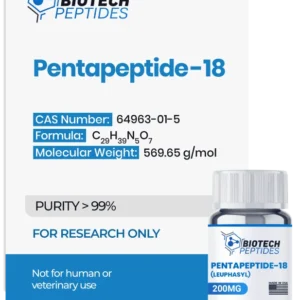
Pentapeptide-18 (Leuphasyl) (200mg) | Biotech Peptides
Pentapeptide-18 (Leuphasyl) (200mg) is a synthetic pentapeptide listed for laboratory and analytical research involving peptide structure and cosmetic-science research models.
Pentapeptide-18 is also known as Leuphasyl and is structurally related to leucine-enkephalin, with a D-alanine residue at position two. Its research background includes investigations into neurotransmitter signaling and topical cosmetic formulations. Reference molecular information:- Listed quantity: 200mg
- Sequence: H-Tyr-D-Ala-Gly-Phe-Leu-OH
- Molecular formula: C₂₉H₃₉N₅O₇
- Molecular weight: Approximately 569.6 g/mol
- CAS number: 64963-01-5
- Alternative name: Leuphasyl
PT-141 (Bremelanotide) (10mg)
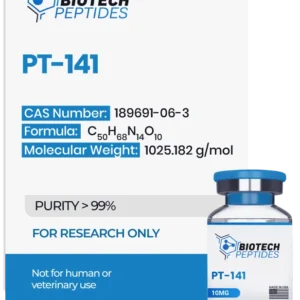
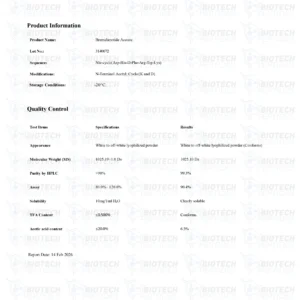
PT-141 (Bremelanotide) (10mg) is offered by Biotech Peptides for laboratory and analytical research. Also called bremelanotide, this synthetic cyclic heptapeptide is a melanocortin receptor agonist studied in relation to MC1R, MC3R, and MC4R signaling.accessdata.fda+2
-
Product: PT-141 (Bremelanotide)
-
Alternative name: Bremelanotide
-
Listed quantity: 10 mg
-
Reference molecular formula: C₅₀H₆₈N₁₄O₁₀
-
Intended use: Laboratory and analytical research only
Review the manufacturer specifications and applicable analytical documentation before selecting material for your protocol.
For research use only. Not for human consumption.


Semax (25mg)
Semax (25mg) is offered by Biotech Peptides for laboratory and analytical research. Semax is a synthetic heptapeptide analogue of ACTH(4-10) studied in relation to neurotrophin gene expression and ischemic injury models. 1041
-
Product: Semax
-
Full name: ACTH(4-7)-Pro-Gly-Pro
-
Listed quantity: 25 mg
-
Reference molecular formula: C₃₉H₅₄N₁₀O₁₀S
-
Intended use: Laboratory and analytical research only
Review the manufacturer specifications and applicable analytical documentation before selecting material for your protocol.
For research use only. Not for human consumption.


TB-500 (Thymosin Beta-4) (10mg)
TB-500 (Thymosin Beta-4) (10mg) is offered by Biotech Peptides for laboratory and analytical research. TB-500 is a synthetic 43-residue peptide derived from thymosin beta-4, studied in relation to cell migration, angiogenesis, and wound-repair signaling. 1153
-
Product: TB-500
-
Full name: Thymosin Beta-4
-
Listed quantity: 10 mg
-
Reference molecular formula: C₂₁₂H₃₅₀N₅₆O₇₈S
-
Intended use: Laboratory and analytical research only
Review the manufacturer specifications and applicable analytical documentation before selecting material for your protocol.
For research use only. Not for human consumption.
