

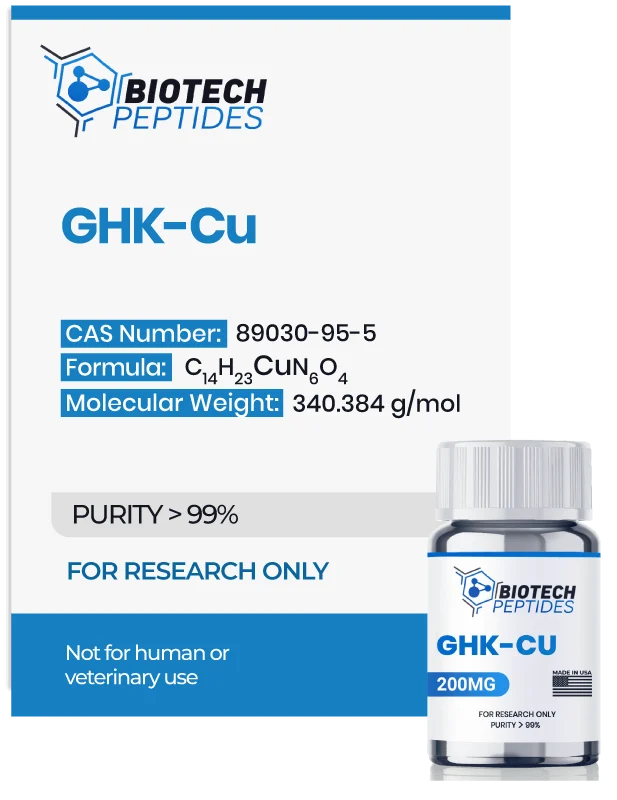
GHK-Cu (200mg)
$186.00
GHK-Cu (200mg), also known as copper tripeptide, is a copper-bound complex of the tripeptide Gly-His-Lys (glycine, histidine and lysine). It has been investigated in laboratory research involving fibroblast activity, extracellular matrix remodelling, MMP-2 expression, growth-factor signalling and oxidative stress.
Product information:
- Product: GHK-Cu
- Listed quantity: 200mg
- Peptide sequence: Gly-His-Lys
- Chemical form: Copper-bound GHK complex
- Alternative name: Copper tripeptide-1
The exact molecular formula and molecular weight depend on the supplied chemical form, including whether an acetate salt is present. Refer to the applicable supplier specification and batch documentation.
For laboratory and analytical research only. Not for human or animal consumption, personal administration, medical treatment, diagnosis or veterinary application.
GHK-Cu (200mg) Peptide
GHK-Cu, also known as copper tripeptide, is a copper-bound complex of the naturally occurring tripeptide Gly-His-Lys. The three amino acids are glycine, histidine and lysine. When GHK binds with copper (II), it forms the copper-peptide complex commonly referred to as GHK-Cu.
GHK-Cu has been investigated in scientific research involving cellular signalling, fibroblast activity, extracellular matrix remodelling and oxidative stress. Researchers have also examined its relationship with matrix metalloproteinases, tissue inhibitors of metalloproteinases and growth-factor expression.
An important distinction exists between GHK and GHK-Cu. GHK is the copper-free tripeptide, whereas GHK-Cu contains a coordinated copper ion. Research findings involving the copper complex should not automatically be attributed to copper-free GHK.
GHK-Cu and Extracellular Matrix Remodelling
One of the established research areas for GHK-Cu is its relationship with extracellular matrix remodelling.
The extracellular matrix (ECM) is a network of proteins and other molecules that provides structural support to cells and tissues. Its components include collagen, proteoglycans and glycoproteins. Matrix remodelling involves the regulated breakdown and formation of these components.
A 2000 study by Siméon and colleagues examined the effects of GHK-Cu on matrix metalloproteinase-2 (MMP-2) production in cultured dermal fibroblasts.
The researchers reported increased MMP-2 levels in the conditioned media of treated fibroblast cultures, alongside increased MMP-2 messenger RNA. The study also reported increased secretion of tissue inhibitors of metalloproteinases TIMP-1 and TIMP-2.
An important observation was that the effect on MMP-2 was reproduced by copper ions but not by copper-free GHK alone. This highlights why the copper-bound form should be considered separately when reviewing experimental findings.
These results provide a research basis for studying GHK-Cu in relation to extracellular matrix regulation and fibroblast activity.
GHK-Cu and Fibroblast Research
Fibroblasts are connective-tissue cells involved in producing and maintaining extracellular matrix components. They are commonly studied in research examining collagen, tissue structure and cellular responses to injury.
Pollard and colleagues investigated GHK-Cu in normal and irradiated human dermal fibroblast cultures in a 2005 study.
The researchers examined cell growth and the production of several growth factors, including basic fibroblast growth factor (bFGF), transforming growth factor beta-1 (TGF-β1) and vascular endothelial growth factor (VEGF).
Their findings included faster population doubling in GHK-Cu-treated fibroblast cultures compared with untreated controls. Irradiated fibroblasts exposed to GHK-Cu also showed increased early production of bFGF and VEGF.
This in-vitro research provides useful background for investigating copper tripeptide interactions with fibroblast growth and growth-factor signalling. It does not establish a clinical treatment effect.
GHK-Cu and Experimental Wound Models
GHK-Cu has also been investigated in experimental wound models.
A 1994 study by Mulder and colleagues examined topical GHK-Cu gel in patients with diabetic foot ulcers. The publication reported differences in ulcer closure and infection rates between the treatment and vehicle groups.
These results are specific to the formulation, application method and clinical conditions examined in that study. They should not be interpreted as evidence that a laboratory research material produces the same outcome.
Other research has examined modified GHK peptides in wound-dressing materials. For example, a 2007 study investigated biotinylated GHK incorporated into collagen-based films in diabetic rat wound models.
The researchers reported differences in wound closure and measurements associated with tissue repair. However, biotinylated GHK incorporated into a collagen film is a specific experimental formulation. Its findings should not be presented as direct evidence for every GHK-Cu preparation.
These studies illustrate the range of experimental approaches used to investigate GHK-related peptides and wound-model mechanisms.
GHK-Cu and Growth-Factor Signalling
Growth factors are signalling proteins involved in the regulation of cell growth, differentiation and tissue organisation.
GHK-Cu has been studied in relation to several growth-factor pathways, particularly in fibroblast models.
In the 2005 Pollard study, researchers investigated basic fibroblast growth factor and vascular endothelial growth factor production in normal and irradiated human dermal fibroblasts exposed to GHK-Cu.
The study reported an early increase in bFGF and VEGF production in treated irradiated fibroblasts compared with untreated controls.
These findings provide a basis for further laboratory investigation of GHK-Cu and growth-factor signalling. The experimental observations should not be interpreted as proof of improved tissue recovery or other clinical outcomes.
GHK-Cu and Skin Research
GHK-Cu has also appeared in research concerning skin structure and photodamage.
Published literature has discussed studies involving topical copper tripeptide formulations and changes in measurements such as skin density, thickness, laxity and wrinkle appearance.
However, the human studies frequently cited in this area were reported as conference abstracts rather than complete peer-reviewed clinical publications. Their findings should therefore be interpreted with appropriate caution.
Laboratory research has also examined GHK-Cu in relation to collagen synthesis, fibroblast activity and extracellular matrix components. These investigations provide scientific context for studying the copper peptide in skin-related experimental models, but they do not establish that this research product is a cosmetic treatment or is suitable for application to skin.
GHK-Cu and Nerve-Related Research
Research has also investigated Gly-His-Lys in experimental models of peripheral nerve regeneration.
A 2005 study by Ahmed and colleagues examined cell-adhesive peptides incorporated into collagen tubes used in a peripheral nerve injury model. The peptides included Gly-His-Lys (GHK), alongside other sequences.
The researchers investigated growth-factor and inflammatory mediator activity during the early stages of regeneration.
An important distinction is that the study examined GHK incorporated into a collagen-based structure. It should not be described as direct proof that the specific GHK-Cu complex supplied here produces the same effects.
GHK-Cu and Oxidative Stress Research
Oxidative stress is associated with the production and accumulation of reactive molecules that can interact with cellular components, including proteins, lipids and DNA.
GHK-Cu has been discussed in research examining its interactions with reactive oxygen species and reactive carbonyl species. Some studies have explored its ability to interact with compounds associated with lipid peroxidation and oxidative damage.
Research reviews have also discussed possible interactions between GHK-related peptides, copper and iron-associated processes.
These mechanisms remain subjects of scientific investigation. Findings from individual chemical, cell-based or animal experiments should not be interpreted as proof of antioxidant protection or a therapeutic effect in humans.
Chemical Specifications
GHK-Cu is a copper-bound form of the Gly-His-Lys tripeptide. Its exact chemical specification depends on the form supplied, including its copper coordination state and whether it contains an acetate counterion or salt component.
The molecular information currently displayed on this product page requires supplier confirmation before it is used as a definitive specification.
- Product name: GHK-Cu
- Listed quantity: 200mg
- Peptide sequence: Gly-His-Lys
- Chemical identity: Copper-bound Gly-His-Lys complex
- Alternative names: GHK-Cu, copper tripeptide, copper tripeptide-1
For accurate formula and molecular-weight information, consult the supplier’s specification for the exact supplied form. Do not use the molecular weight of copper-free GHK as the molecular weight of GHK-Cu.
Research Peptides at Biotech Peptides
Biotech Peptides lists GHK-Cu (200mg) for laboratory and analytical research. Its research background includes investigations into fibroblast activity, extracellular matrix remodelling, MMP-2 expression and growth-factor signalling.
When comparing research peptides for sale, it is important to review the chemical identity, listed quantity and available product documentation. General scientific literature describes the reference compound and does not independently verify the identity, purity or analytical results of an individual product batch.
Explore our research peptide collection to view other listed research materials. For order-processing and delivery information, visit our Shipping & Delivery page.
Frequently Asked Questions
What is GHK-Cu?
GHK-Cu is a copper-bound complex of the tripeptide Gly-His-Lys, consisting of glycine, histidine and lysine coordinated with copper.
Is GHK-Cu the same as GHK Basic?
No. GHK Basic refers to the copper-free Gly-His-Lys tripeptide. GHK-Cu is the copper-bound complex. Their chemical compositions and molecular weights are different.
What is GHK-Cu also called?
GHK-Cu is also known as copper tripeptide, copper tripeptide-1 and Gly-His-Lys copper complex.
What research has been conducted on GHK-Cu?
Research has investigated GHK-Cu in relation to fibroblast activity, extracellular matrix remodelling, MMP-2 and TIMP expression, growth-factor signalling, wound models and oxidative stress.
Does GHK-Cu have the same molecular weight as GHK Basic?
No. Copper-free GHK and the copper-bound complex have different molecular compositions and molecular weights. The exact value for GHK-Cu also depends on the supplied chemical form, including any acetate component.
Is GHK-Cu intended for human or animal consumption?
No. This product is intended exclusively for laboratory and analytical research. It is not intended for human or animal consumption, personal administration, medical treatment, diagnosis or veterinary application.
Research Use Only
GHK-Cu (200mg) is supplied strictly for laboratory and analytical research purposes. It is not intended for human or animal consumption, personal administration, medical treatment, diagnosis or veterinary application.
All scientific information on this page is provided for educational and research reference purposes. Researchers should review the relevant scientific literature, supplier specifications and available batch-specific documentation before using research materials in an appropriate laboratory setting.
| Brand | Biotech Peptides |
|---|
Related products


ACE-031 (1mg)
ACE-031 (1mg) is offered by Biotech Peptides for laboratory and analytical research. ACE-031 is a soluble fusion protein comprising the extracellular domain of activin receptor type IIB fused to the Fc portion of human IgG1, studied in relation to myostatin signaling and muscle-mass regulation. 1198
-
Product: ACE-031
-
Alternative name: Ramatercept
-
Listed quantity: 1 mg
-
Reference molecular weight: 77.24 kDa
-
Intended use: Laboratory and analytical research only
Review the manufacturer specifications and applicable analytical documentation before selecting material for your protocol.
For research use only. Not for human consumption.
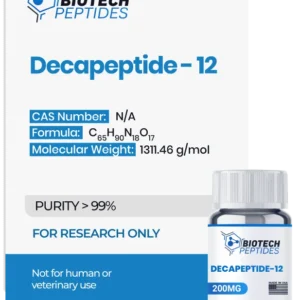
Decapeptide-12 (200mg)
Decapeptide-12 (200mg), also known by its sequence YRSRKYSSWY, is a synthetic ten-amino-acid peptide investigated for its interaction with tyrosinase and its role in experimental melanogenesis research. Published studies have examined its effects on tyrosinase activity and melanin content in laboratory models. Listed for laboratory and analytical research.
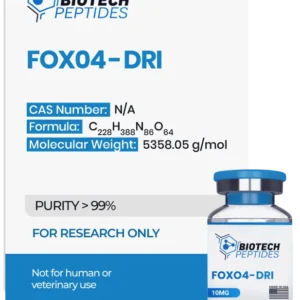
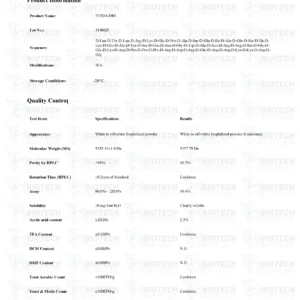
FOXO4-DRI (Proxofim) (10mg)
FOXO4-DRI (Proxofim) (10mg) is offered by Biotech Peptides for laboratory and analytical research. FOXO4-DRI is a synthetic D-retro-inverso peptide, also called Proxofim, studied in relation to FOXO4-p53 signaling and senescent-cell apoptosis. 1241
-
Product: FOXO4-DRI
-
Alternative name: Proxofim
-
Listed quantity: 10 mg
-
Reference molecular formula: C₂₂₈H₃₈₈N₈₆O₆₄
-
Intended use: Laboratory and analytical research only
Review the manufacturer specifications and applicable analytical documentation before selecting material for your protocol.
For research use only. Not for human consumption.


MGF (Mechano-Growth Factor) (5mg)
MGF (Mechano-Growth Factor) (5mg) is offered by Biotech Peptides for laboratory and analytical research. MGF is a synthetic 24-residue peptide derived from the E-domain of IGF-1Ec, studied in relation to muscle-cell proliferation, tissue-repair signaling, and cardiac ischemia models. 1065
-
Product: MGF
-
Full name: Mechano-Growth Factor
-
Listed quantity: 5 mg
-
Reference molecular formula: C₁₂₄H₂₀₄N₄₂O₄₁S
-
Intended use: Laboratory and analytical research only
Review the manufacturer specifications and applicable analytical documentation before selecting material for your protocol.
For research use only. Not for human consumption.
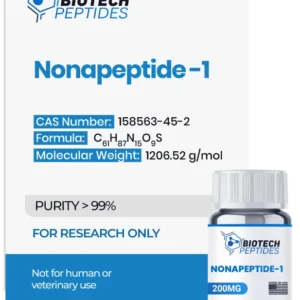
Nonapeptide-1 (200mg)
- Product: Nonapeptide-1
- Alternative name: Melanostatine-5
- Listed quantity: 200mg
- Peptide length: 9 amino acids
- Reference sequence: Met-Pro-D-Phe-Arg-D-Trp-Phe-Lys-Pro-Val-NH₂
- CAS number: 158563-45-2
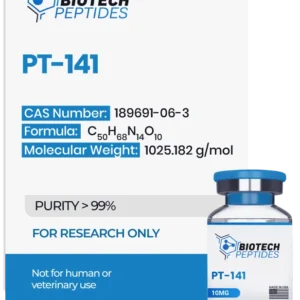
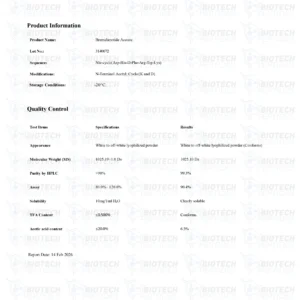
PT-141 (Bremelanotide) (10mg)
PT-141 (Bremelanotide) (10mg) is offered by Biotech Peptides for laboratory and analytical research. Also called bremelanotide, this synthetic cyclic heptapeptide is a melanocortin receptor agonist studied in relation to MC1R, MC3R, and MC4R signaling.accessdata.fda+2
-
Product: PT-141 (Bremelanotide)
-
Alternative name: Bremelanotide
-
Listed quantity: 10 mg
-
Reference molecular formula: C₅₀H₆₈N₁₄O₁₀
-
Intended use: Laboratory and analytical research only
Review the manufacturer specifications and applicable analytical documentation before selecting material for your protocol.
For research use only. Not for human consumption.
Selank (10mg)
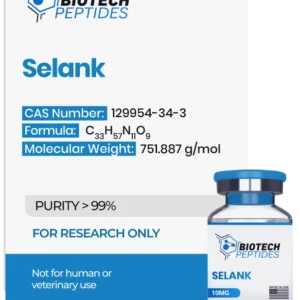
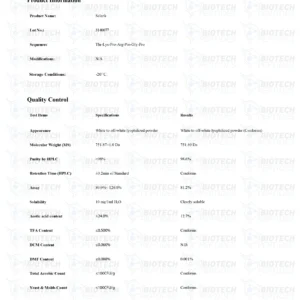
Selank (10mg) is offered by Biotech Peptides for laboratory and analytical research. Selank is a synthetic 7-residue analogue of tuftsin studied in relation to GABAergic signaling, immune modulation, and neurotrophic factor expression. 1166
-
Product: Selank
-
Full name: Tuftsin-Pro-Gly-Pro
-
Listed quantity: 10 mg
-
Reference molecular formula: C₃₃H₅₇N₁₁O₉
-
Intended use: Laboratory and analytical research only
Review the manufacturer specifications and applicable analytical documentation before selecting material for your protocol.
For research use only. Not for human consumption.


TB-500 (Thymosin Beta-4) (10mg)
TB-500 (Thymosin Beta-4) (10mg) is offered by Biotech Peptides for laboratory and analytical research. TB-500 is a synthetic 43-residue peptide derived from thymosin beta-4, studied in relation to cell migration, angiogenesis, and wound-repair signaling. 1153
-
Product: TB-500
-
Full name: Thymosin Beta-4
-
Listed quantity: 10 mg
-
Reference molecular formula: C₂₁₂H₃₅₀N₅₆O₇₈S
-
Intended use: Laboratory and analytical research only
Review the manufacturer specifications and applicable analytical documentation before selecting material for your protocol.
For research use only. Not for human consumption.