

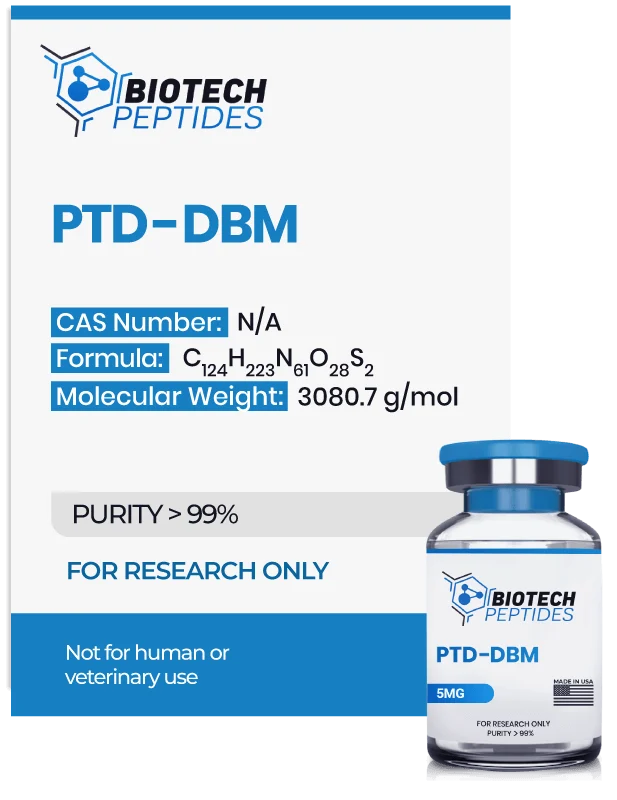

PTD-DBM (5mg)
$86.00
PTD-DBM (5mg) is a synthetic protein transduction domain-fused Dishevelled-binding motif peptide. It has been investigated for its ability to interfere with the interaction between CXXC5 and Dishevelled (Dvl), a regulatory mechanism involved in Wnt/β-catenin signalling.
Research has examined PTD-DBM in relation to hair follicle development, wound-induced hair follicle neogenesis, fibroblast activity and collagen production in experimental models.
Product specifications:
- Product: PTD-DBM
- Listed quantity: 5mg
- Peptide sequence: RRRRRRRRGGGGRKTGHQICKFRKC
- Molecular formula: C₁₂₄H₂₂₃N₆₁O₂₈S₂*
- Molecular weight: 3080.7 g/mol*
- Research focus: CXXC5-Dvl interaction and Wnt/β-catenin signalling
The formula and molecular weight should be confirmed against the exact supplied oxidation state and chemical form.
For laboratory and analytical research only. Not for human or animal consumption, personal administration, medical treatment, diagnosis or veterinary application.
PTD-DBM (5mg) Peptide
PTD-DBM stands for Protein Transduction Domain-fused Dishevelled-Binding Motif. It is a synthetic research peptide developed to interfere with the interaction between CXXC-type zinc finger protein 5 (CXXC5) and Dishevelled (Dvl).
This protein interaction is important in the regulation of the Wnt/β-catenin signalling pathway, which has been investigated in research involving cellular development, tissue repair and hair follicle biology.
PTD-DBM was studied by researchers led by Professor Kang-Yell Choi and colleagues at Yonsei University in South Korea. Their work examined how CXXC5 interacts with Dvl and how disrupting this interaction may influence Wnt/β-catenin signalling.
Published studies have investigated PTD-DBM in cultured human cells and animal models, particularly in relation to hair follicle development, wound-induced hair follicle neogenesis and cutaneous wound repair.
PTD-DBM and the CXXC5-Dvl Interaction
CXXC5 is a protein involved in regulating several cellular signalling processes. Research has identified it as a negative regulator of the Wnt/β-catenin pathway through its interaction with Dishevelled proteins.
Dishevelled, commonly abbreviated as Dvl, is an intracellular signalling protein involved in transmitting Wnt-related signals.
The interaction between CXXC5 and Dvl can contribute to suppression of Wnt/β-catenin signalling. PTD-DBM was developed as a competing peptide designed to interfere with this protein-protein interaction.
By disrupting the CXXC5-Dvl interaction, PTD-DBM has been investigated for its ability to reduce this negative regulatory effect and increase β-catenin signalling in experimental systems.
This mechanism provides the central scientific basis for PTD-DBM research.
PTD-DBM and Wnt/β-Catenin Signalling
The Wnt/β-catenin pathway is an important cellular signalling system involved in development, cell differentiation, tissue organisation and regeneration.
Under particular conditions, Wnt signalling stabilises β-catenin, allowing it to accumulate and move into the cell nucleus. There, β-catenin interacts with transcription factors, including T-cell factor and lymphoid enhancer factor proteins, to regulate the expression of target genes.
The CXXC5-Dvl interaction acts as one of the regulatory mechanisms that can influence this pathway.
Research has investigated whether PTD-DBM can interfere with this interaction and alter β-catenin activity. In experimental fibroblast models, PTD-DBM was associated with increased β-catenin expression and nuclear localisation.
These findings make the peptide relevant to research into Wnt signalling, cellular proliferation and extracellular matrix regulation.
PTD-DBM and Hair Follicle Research
One of the most widely discussed research areas involving PTD-DBM is hair follicle biology.
A 2017 study published in the Journal of Investigative Dermatology, titled Targeting of CXXC5 by a Competing Peptide Stimulates Hair Regrowth and Wound-Induced Hair Neogenesis, investigated the relationship between CXXC5, Dishevelled and Wnt/β-catenin signalling.
The researchers reported increased CXXC5 expression in miniaturised hair follicles and arrector pili muscles in human balding scalp samples. They also examined the inhibitory effects of CXXC5 on alkaline phosphatase activity and cell proliferation in human hair follicle dermal papilla cells.
The study further investigated CXXC5-deficient mice and a competing peptide designed to disrupt the CXXC5-Dvl interaction.
In the experimental mouse models, disrupting this interaction activated Wnt/β-catenin signalling and was associated with accelerated hair regrowth and wound-induced hair follicle neogenesis.
The findings provide a research basis for investigating PTD-DBM and the molecular mechanisms involved in hair follicle development. They do not establish that PTD-DBM is an effective treatment for human hair loss.
PTD-DBM and Androgenetic Alopecia Research
Androgenetic alopecia is a research area involving changes in hair follicle structure, follicular miniaturisation and alterations in the hair growth cycle.
The hair follicle cycle is commonly divided into three main stages:
- Anagen: The active growth phase.
- Catagen: The transitional regression phase.
- Telogen: The resting phase.
The duration and regulation of these stages have been investigated in research involving androgen signalling, follicular development and Wnt/β-catenin activity.
The 2017 PTD-DBM study examined CXXC5 expression in human balding scalp samples and investigated its relationship with hair follicle dermal papilla cell activity.
The researchers also examined how disrupting the CXXC5-Dvl interaction influenced hair regrowth in mouse models.
These findings provide a molecular research context for studying PTD-DBM in relation to follicular signalling and androgenetic alopecia models. They should not be interpreted as proof of human hair regrowth or a clinical treatment effect.
PTD-DBM and Wound-Induced Hair Follicle Neogenesis
Wound-induced hair follicle neogenesis (WIHN) describes the formation of new hair follicles during the repair of certain skin injuries.
This process has attracted scientific interest because it involves interactions between wound repair, cellular signalling and hair follicle development.
The 2017 study investigated whether disrupting CXXC5-Dvl interactions could influence this process through activation of Wnt/β-catenin signalling.
The researchers reported evidence of increased hair follicle formation in experimental wound models exposed to the competing peptide.
This research provides an additional area of investigation for PTD-DBM beyond conventional studies of hair follicle growth. The reported findings relate to specific animal wound models and should not be generalised to human skin.
PTD-DBM (5mg) and Cutaneous Wound Repair
A separate 2015 study published in the Journal of Experimental Medicine examined the role of CXXC5 in cutaneous wound healing.
The researchers identified CXXC5 as a negative regulator of Wnt/β-catenin signalling and investigated its interaction with Dishevelled proteins.
The study reported that PTD-DBM disrupted the CXXC5-Dvl interaction and increased β-catenin and collagen production in cultured human dermal fibroblasts.
Researchers also examined wound healing in mice treated with PTD-DBM. In certain experiments, PTD-DBM was combined with valproic acid, a glycogen synthase kinase-3β inhibitor that also activates Wnt/β-catenin signalling.
The combination produced a greater wound-healing response than either intervention alone under the tested conditions.
These findings provide a scientific basis for studying PTD-DBM in relation to fibroblast activity, collagen deposition and cutaneous wound repair. The results should be interpreted in the context of the experimental models and treatment combinations used in the publication.
PTD-DBM (5mg) and Fibroblast Activity
Fibroblasts are connective-tissue cells responsible for producing and maintaining components of the extracellular matrix, including collagen.
Their migration, proliferation and matrix production are important subjects in research involving wound repair and tissue organisation.
The 2015 PTD-DBM study investigated changes in several markers associated with fibroblast activity.
Researchers reported increased expression of:
- β-catenin
- Alpha-smooth muscle actin (α-SMA)
- Collagen type I
The study also examined changes in fibroblast migration and stress-fibre formation.
These observations support further investigation into the relationship between CXXC5-Dvl signalling, β-catenin activity and fibroblast behaviour in experimental systems.
PTD-DBM and Collagen Production
Collagen is a major structural component of the extracellular matrix and is involved in maintaining tissue organisation.
The 2015 study investigated collagen production following interference with the CXXC5-Dvl interaction.
PTD-DBM exposure was associated with increased collagen I expression in cultured human dermal fibroblasts. The researchers also examined collagen-related changes in experimental wound models.
These findings provide a research context for investigating the relationship between PTD-DBM, Wnt/β-catenin signalling and extracellular matrix production.
They do not establish that PTD-DBM produces a particular collagen-related outcome in humans.
Chemical Specifications
The following details describe the chemical form currently listed for PTD-DBM. The molecular formula and mass should be checked against the supplier’s exact specification, particularly the oxidation state of its two cysteine residues.
- Product name: PTD-DBM
- Listed quantity: 5mg
- Full name: Protein Transduction Domain-fused Dishevelled-Binding Motif
- Sequence: RRRRRRRRGGGGRKTGHQICKFRKC
- Molecular formula: C₁₂₄H₂₂₃N₆₁O₂₈S₂*
- Molecular weight: 3080.7 g/mol*
- CAS number: 1609454-11-6 (verify against the supplied chemical form)
The listed formula corresponds to an oxidised, disulfide-bridged form. The reduced form has two additional hydrogen atoms and a different molecular weight. Confirm the exact chemical form with the manufacturer before treating these specifications as definitive.
The chemical specifications describe the reference material and do not independently verify the identity, purity or analytical results of an individual product batch.
Research Peptides at Biotech Peptides
Biotech Peptides lists PTD-DBM (5mg) for laboratory and analytical research. Its research background includes investigations into CXXC5-Dvl protein interactions, Wnt/β-catenin signalling, fibroblast activity and hair follicle development.
When comparing research peptides for sale, review the listed chemical specifications and available product documentation. Scientific publications describe the reference peptide and experimental conditions used in research; they do not independently confirm the identity or analytical quality of a specific commercial batch.
Explore our research peptide collection to view other listed research materials. For order processing and delivery information, visit our Shipping & Delivery page.
Frequently Asked Questions
What is PTD-DBM?
PTD-DBM is a synthetic peptide known as Protein Transduction Domain-fused Dishevelled-Binding Motif. It has been investigated for its ability to interfere with the interaction between CXXC5 and Dishevelled proteins.
What does PTD-DBM stand for?
PTD-DBM stands for Protein Transduction Domain-fused Dishevelled-Binding Motif.
What is the CXXC5-Dvl interaction?
CXXC5 and Dishevelled are proteins involved in regulating Wnt/β-catenin signalling. Their interaction contributes to negative regulation of this pathway. PTD-DBM has been studied as a competing peptide designed to interfere with this interaction.
What is the Wnt/β-catenin pathway?
The Wnt/β-catenin pathway is a cellular signalling system involved in processes such as development, cell differentiation and tissue organisation. It has also been investigated in research involving hair follicle development and wound repair.
What research has been conducted on PTD-DBM?
Published research has investigated PTD-DBM in relation to CXXC5-Dvl interactions, Wnt/β-catenin signalling, hair follicle development, wound-induced hair follicle neogenesis, fibroblast activity and collagen production.
Is PTD-DBM the same as a conventional hair-growth peptide?
PTD-DBM has a different molecular structure and research focus from peptides commonly discussed in other hair-related research. Its primary research mechanism involves the CXXC5-Dvl interaction and Wnt/β-catenin signalling.
Is PTD-DBM intended for human or animal consumption?
No. This product is intended exclusively for laboratory and analytical research. It is not intended for human or animal consumption, personal administration, medical treatment, diagnosis or veterinary application.
Research Use Only
PTD-DBM (5mg) is supplied strictly for laboratory and analytical research purposes. It is not intended for human or animal consumption, personal administration, medical treatment, diagnosis or veterinary application.
All scientific information on this page is provided for educational and research reference purposes. Researchers should review the relevant scientific literature, supplier specifications and available batch-specific documentation before using research materials in an appropriate laboratory setting.
| Brand | Biotech Peptides |
|---|
Related products

Lipopeptide (Biopeptide EL) (200mg)
- Product name: Lipopeptide (Biopeptide EL)
- Listed quantity: 200mg
- Chemical name: Palmitoyl Hexapeptide-12
- Peptide sequence: Val-Gly-Val-Ala-Pro-Gly (VGVAPG)
- Molecular formula: C₃₈H₆₈N₆O₈
- Molecular weight: Approximately 737.0 g/mol
- CAS number: 171263-26-6



Oxytocin (10mg)
Oxytocin (10mg) is offered by Biotech Peptides for laboratory and analytical research. Oxytocin is a cyclic nonapeptide hormone and neuropeptide studied in relation to social behavior, reproduction, wound healing, and muscle regeneration. 1015
-
Product: Oxytocin
-
Alternative name: Endopituitrina
-
Listed quantity: 10 mg
-
Reference molecular formula: C₄₃H₆₆N₁₂O₁₂S₂
-
Intended use: Laboratory and analytical research only
Review the manufacturer specifications and applicable analytical documentation before selecting material for your protocol.
For research use only. Not for human consumption.
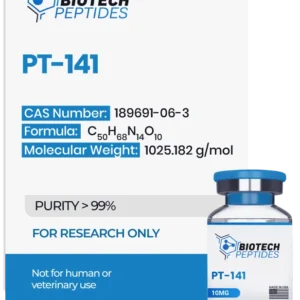
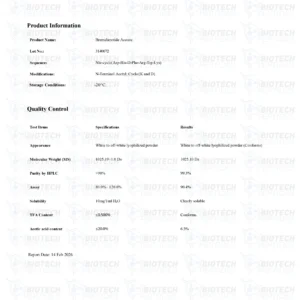
PT-141 (Bremelanotide) (10mg)
PT-141 (Bremelanotide) (10mg) is offered by Biotech Peptides for laboratory and analytical research. Also called bremelanotide, this synthetic cyclic heptapeptide is a melanocortin receptor agonist studied in relation to MC1R, MC3R, and MC4R signaling.accessdata.fda+2
-
Product: PT-141 (Bremelanotide)
-
Alternative name: Bremelanotide
-
Listed quantity: 10 mg
-
Reference molecular formula: C₅₀H₆₈N₁₄O₁₀
-
Intended use: Laboratory and analytical research only
Review the manufacturer specifications and applicable analytical documentation before selecting material for your protocol.
For research use only. Not for human consumption.
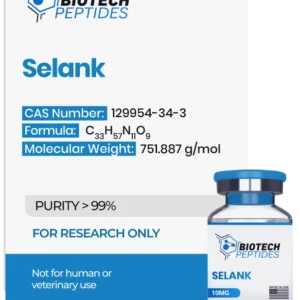
Selank (10mg)
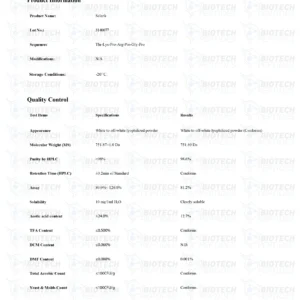
Selank (10mg) is offered by Biotech Peptides for laboratory and analytical research. Selank is a synthetic 7-residue analogue of tuftsin studied in relation to GABAergic signaling, immune modulation, and neurotrophic factor expression. 1166
-
Product: Selank
-
Full name: Tuftsin-Pro-Gly-Pro
-
Listed quantity: 10 mg
-
Reference molecular formula: C₃₃H₅₇N₁₁O₉
-
Intended use: Laboratory and analytical research only
Review the manufacturer specifications and applicable analytical documentation before selecting material for your protocol.
For research use only. Not for human consumption.


Semax (25mg)
Semax (25mg) is offered by Biotech Peptides for laboratory and analytical research. Semax is a synthetic heptapeptide analogue of ACTH(4-10) studied in relation to neurotrophin gene expression and ischemic injury models. 1041
-
Product: Semax
-
Full name: ACTH(4-7)-Pro-Gly-Pro
-
Listed quantity: 25 mg
-
Reference molecular formula: C₃₉H₅₄N₁₀O₁₀S
-
Intended use: Laboratory and analytical research only
Review the manufacturer specifications and applicable analytical documentation before selecting material for your protocol.
For research use only. Not for human consumption.
Sermorelin (5mg)
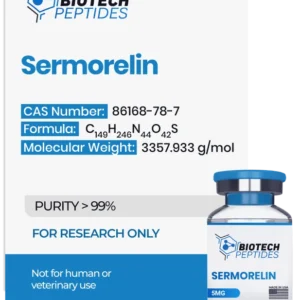
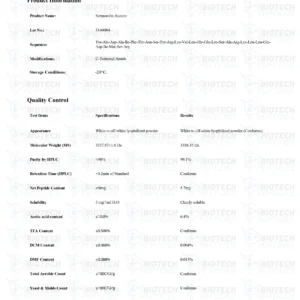
Sermorelin (5mg) is offered by Biotech Peptides for laboratory and analytical research. Sermorelin is a synthetic 29-residue GHRH analogue studied in relation to growth hormone secretion, receptor signaling, and neuroendocrine pathways. 1159
-
Product: Sermorelin
-
Full name: GHRH(1-29)-NH2
-
Listed quantity: 5 mg
-
Reference molecular formula: C₁₄₉H₂₄₆N₄₄O₄₂S
-
Intended use: Laboratory and analytical research only
Review the manufacturer specifications and applicable analytical documentation before selecting material for your protocol.
For research use only. Not for human consumption.


TB-500 (Thymosin Beta-4) (10mg)
TB-500 (Thymosin Beta-4) (10mg) is offered by Biotech Peptides for laboratory and analytical research. TB-500 is a synthetic 43-residue peptide derived from thymosin beta-4, studied in relation to cell migration, angiogenesis, and wound-repair signaling. 1153
-
Product: TB-500
-
Full name: Thymosin Beta-4
-
Listed quantity: 10 mg
-
Reference molecular formula: C₂₁₂H₃₅₀N₅₆O₇₈S
-
Intended use: Laboratory and analytical research only
Review the manufacturer specifications and applicable analytical documentation before selecting material for your protocol.
For research use only. Not for human consumption.