

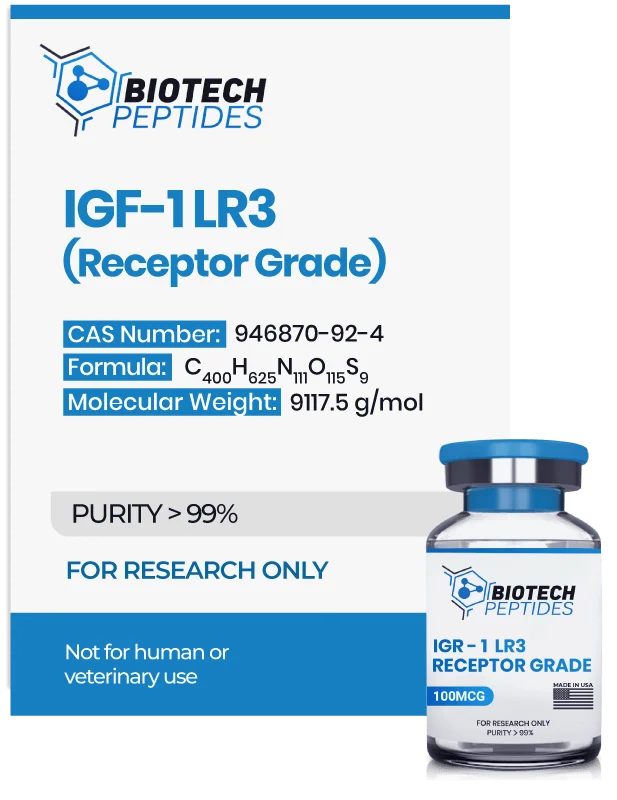
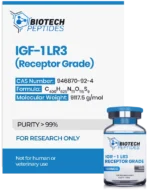
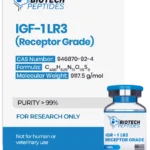
Receptor Grade IGF-1 LR3 (100mcg)
$27.00
Receptor Grade IGF-1 LR3 (100mcg) is listed by Biotech Peptides for laboratory and analytical research. Receptor Grade IGF-1 LR3 (100mcg)is an 83-amino-acid analogue of human insulin-like growth factor I, investigated in cell-culture systems and studies of IGF-binding proteins.pubmed.ncbi.nlm.nih+1
-
Product: IGF-1 LR3
-
Listed grade designation: Receptor Grade
-
Listed quantity: 100 mcg
-
Reference length: 83 amino acids
-
Intended use: Laboratory and analytical research only
Review the manufacturer’s grade definition, structural specifications, and applicable analytical documentation before selecting material for your assay.
For research use only. Not for human consumption.
Receptor Grade IGF-1 LR3 (100mcg) for Laboratory Research
IGF-1 LR3 (100mcg) is listed by Biotech Peptides under the product designation Receptor Grade IGF-1 LR3. The reference compound is an extended analogue of human insulin-like growth factor I, developed with modifications that reduce its affinity for IGF-binding proteins.sigmaaldrich
For laboratories looking to buy Receptor Grade IGF-1 LR3 (100mcg), selection should be based on the required chemical identity, structural integrity, analytical characteristics, and assay-specific performance not the grade name alone.
Explore our research peptides for sale to review other laboratory-use listings.
Product Information
| Property | Listing information |
|---|---|
| Product name | IGF-1 LR3 |
| Listed grade designation | Receptor Grade |
| Alternative research name | Long R3 IGF-I |
| Listed quantity | 100 mcg |
| Intended application | Laboratory and analytical research |
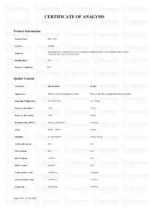
| Documentation inquiries | Include the product name and batch identifier, where available |
The 100 mcg designation describes the quantity stated for this listing. It does not independently establish protein content, concentration, receptor-binding activity, or biological potency.
Receptor Grade IGF-1 LR3 (100mcg) Reference Structure
The reference analogue contains the 70-amino-acid human IGF-I sequence with two principal modifications: replacement of glutamic acid by arginine at position 3 of mature IGF-I and addition of a 13-amino-acid N-terminal extension. Together, these produce an 83-amino-acid polypeptide.
| Reference characteristic | Information |
|---|---|
| Polypeptide length | 83 amino acids |
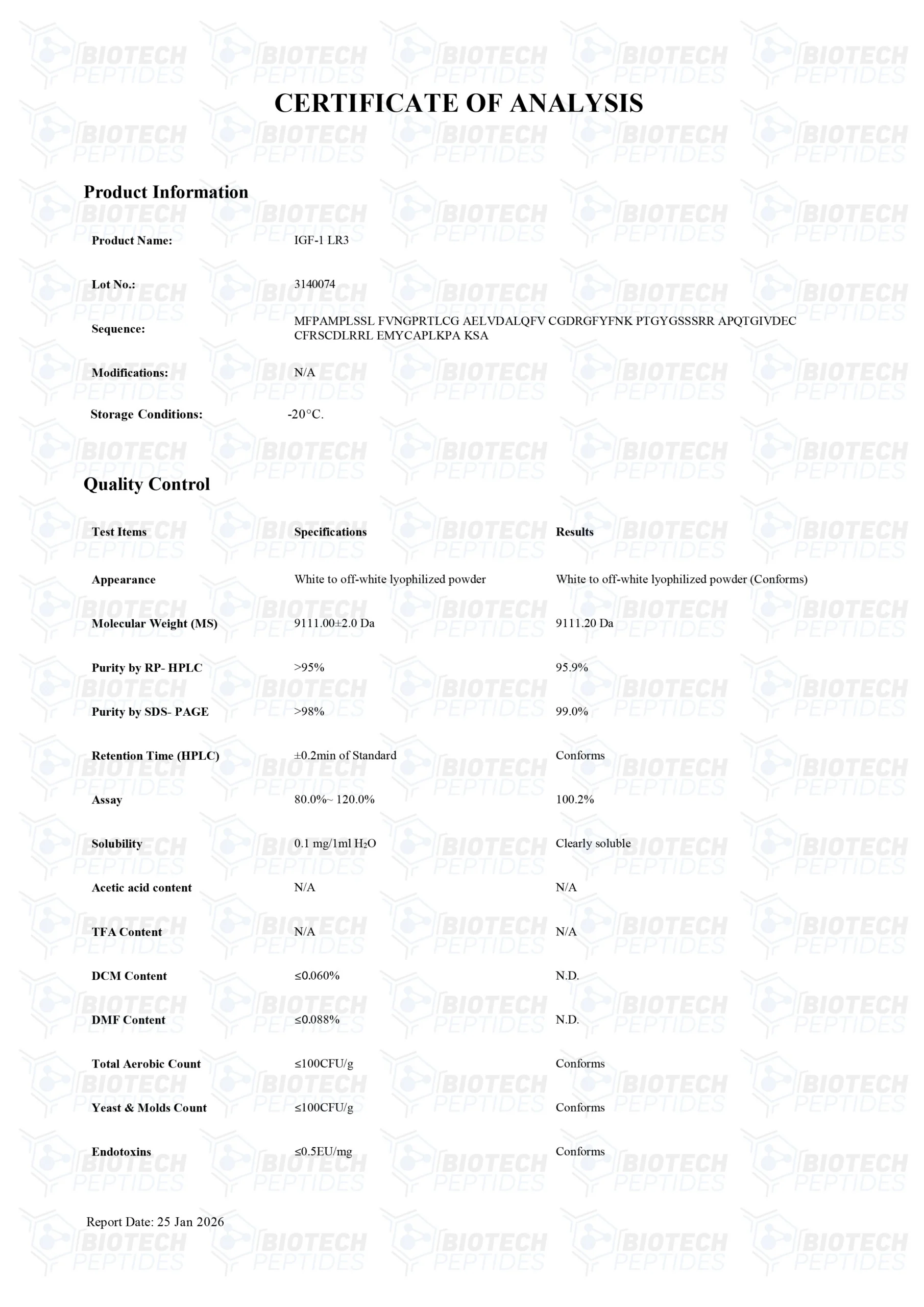
| N-terminal extension | MFPAMPLSSLFVN |
| Substitution in mature IGF-I | Glu3 → Arg |
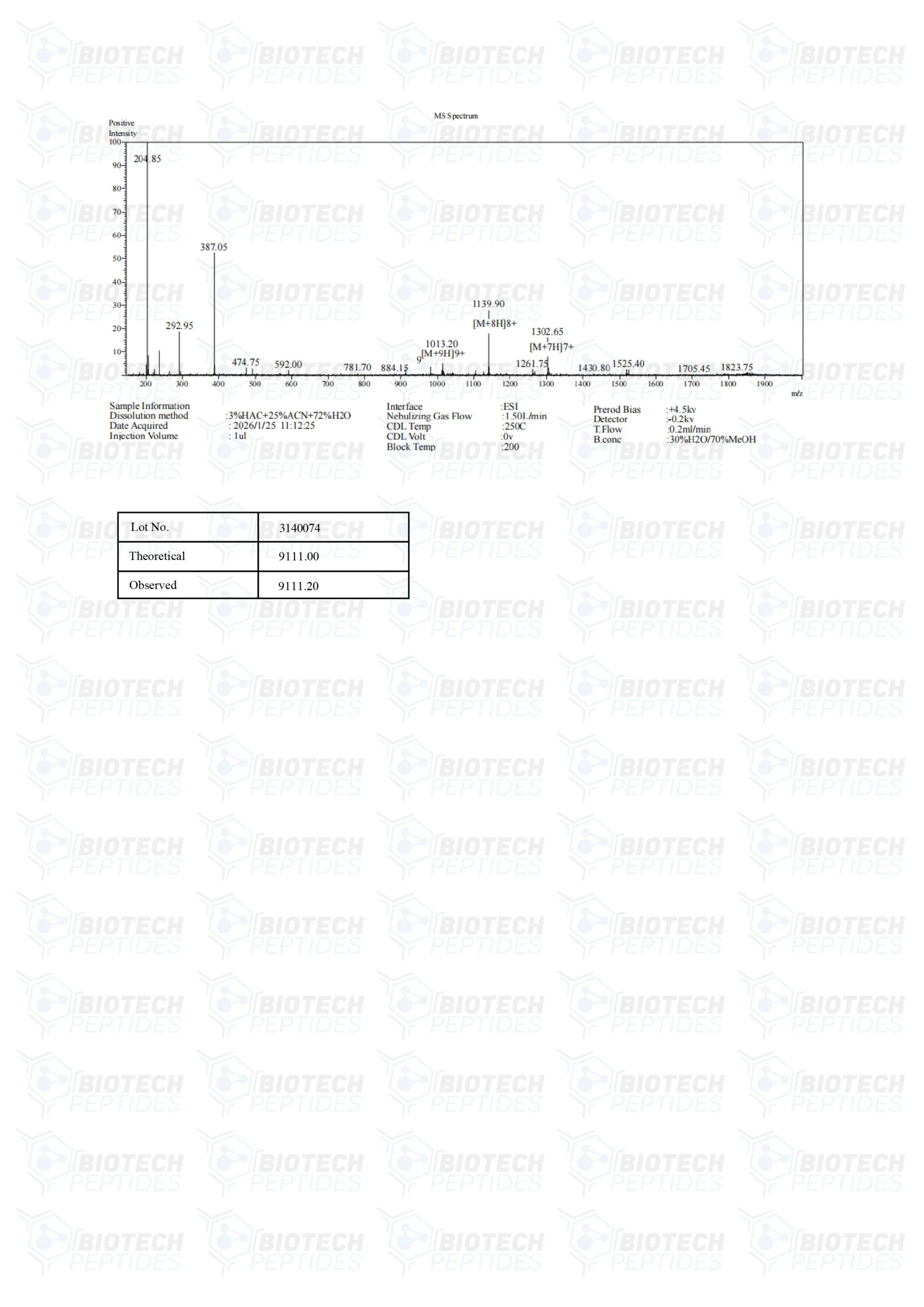
| Approximate molecular size | 9.1 kDa |
The sequence and approximate molecular size are documented in technical reference materials. They do not confirm the production method, folding, disulfide connectivity, or composition of this commercial batch.sigmaaldrich+1
IGF-Binding Protein Research
IGF-binding proteins, commonly abbreviated IGFBPs, influence the availability and activity of IGF ligands. Reduced affinity for these proteins is an important distinguishing feature of the LR3 analogue.
A primary study comparing IGF-I and Long R3 IGF-I in bovine embryo cultures reported substantially lower binding of the LR3 analogue to IGFBPs. The two compounds also differed in their effects at different stages of embryo development, illustrating that experimental performance depends on the biological system and endpoint.
Read the primary study comparing IGF-I and Long R3 IGF-I for the methods and findings.
Reduced binding to IGFBPs should not be rewritten as proof of stronger affinity for the IGF-I receptor. Binding-protein affinity, receptor affinity, and observed biological potency are separate measurements.
Cell-Culture Research
A study by Morris and Schmid compared insulin and Long R3 IGF-I in two serum-free Chinese hamster ovary—CHO—cell lines expressing recombinant proteins. Investigators examined cell growth, viability, and production, making the work relevant to research on culture supplementation and process performance.
Read the study of Long R3 IGF-I in serum-free CHO cultures for the cell-line characteristics and experimental conditions.
Results from a particular culture system do not establish an optimal concentration or guaranteed productivity in another system. Likewise, increased cell growth is not automatically the appropriate endpoint for every assay.
Understanding the Receptor Grade Designation
“Receptor Grade” is the grade name supplied for this listing. To evaluate its relevance, review the manufacturer’s stated acceptance criteria and the tests used to establish them.
Depending on the intended assay, important questions may include:
-
What purity method and acceptance threshold define the grade?
-
Has receptor-binding activity been measured?
-
Is a cell-based activity result available?
-
Are folding and structural integrity addressed?
-
Are aggregation or endotoxin results documented where required?
-
Does the report correspond to the supplied batch?
A grade designation should not replace the measurements required by your protocol. Do not infer that another grade is unsuitable for biological work or that this grade guarantees assay performance.
Research Limitations
Receptor Grade IGF-1 LR3 (100mcg) research should be interpreted separately from studies of unmodified IGF-I. Sequence modifications and differences in IGFBP binding can affect experimental outcomes.
Animal findings also vary across models. For example, a published pig study reported reduced growth despite growth-promoting observations discussed for rat models. Such differences argue against presenting a universal anabolic effect.
Published evidence does not establish the identity, purity, quantity, or biological activity of the material supplied with this listing. This product description does not provide human dosing, administration instructions, or treatment recommendations.
Documentation and Batch Verification
Before selecting Receptor Grade IGF-1 LR3 (100mcg), review the documentation associated with the exact material being supplied. Relevant information may include:
-
Product name and batch or lot identifier.
-
Manufacturer’s definition of Receptor Grade.
-
Sequence, terminal groups, and chemical form.
-
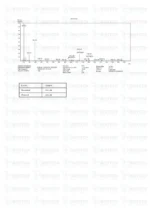
Identity-testing methods and reported results.
-
Structural-integrity and aggregation information.
-
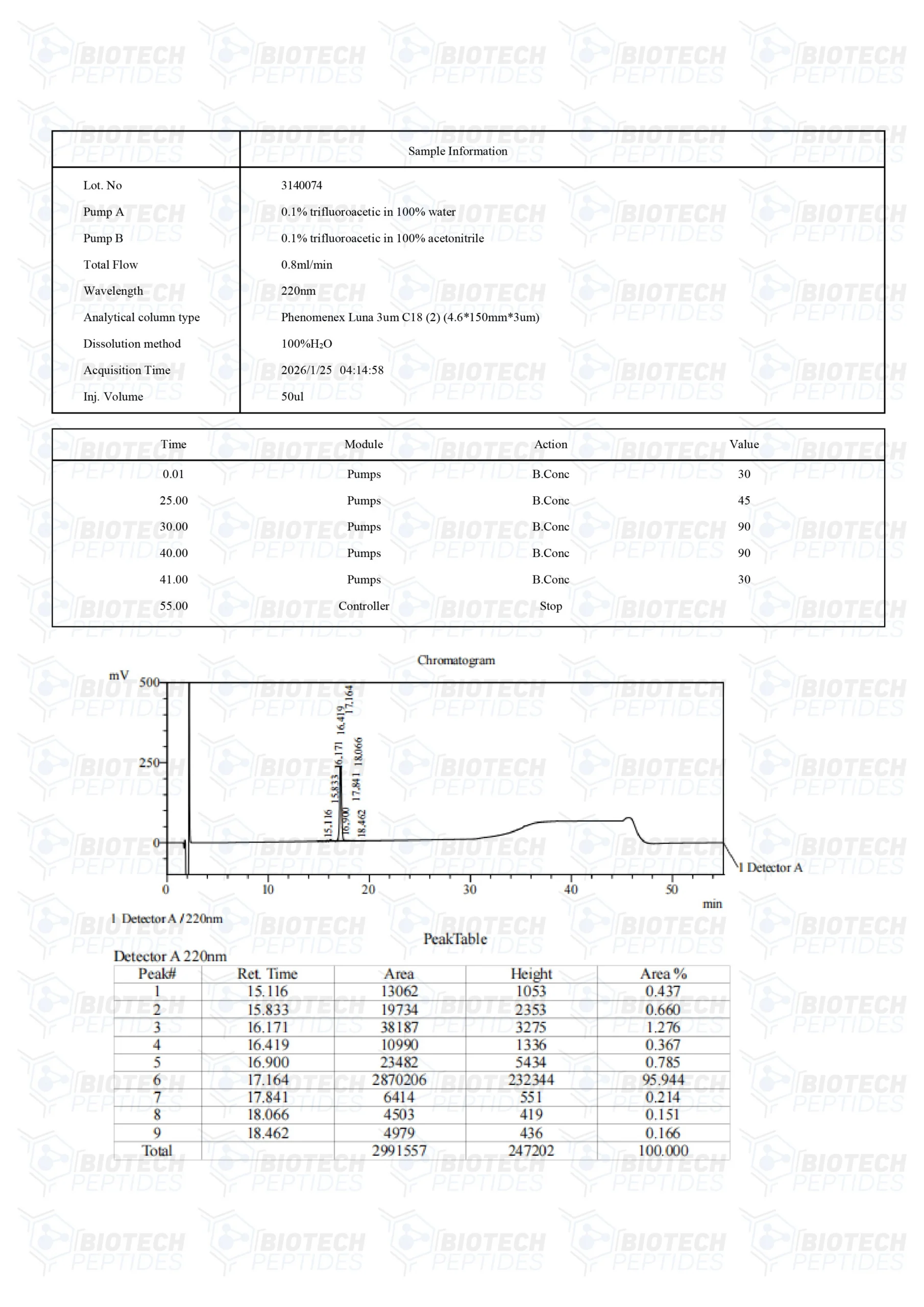
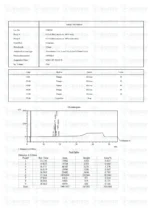
Purity-testing methods and supporting data.
-
Protein-content or quantity measurements.
-
Receptor-binding or cell-based activity results, where required.
-
Endotoxin results, where relevant to the assay.
-
Product-specific storage and handling instructions.
Do not assume that these tests have been performed unless the applicable documentation states so.
For inquiries, provide the product name, batch number where available, and the specific information your laboratory requires.
Storage and Handling
Follow the product-specific instructions supplied with the material and your laboratory’s applicable procedures.
Do not transfer storage temperatures, shelf-life claims, or preparation instructions from another manufacturer’s formulation to this listing. Obtain clarification if documented instructions are unavailable or unclear.
Frequently Asked Questions About Receptor Grade IGF-1 LR3 (100mcg)
What does LR3 mean?
“Long” refers to the N-terminal extension, while “R3” identifies the arginine substitution at position 3 of mature IGF-I. The reference analogue contains 83 amino acids.
Does lower IGFBP affinity mean stronger receptor binding?
Not necessarily. Binding to IGFBPs and binding to the IGF-I receptor are different properties. Evaluate each using the appropriate experimental evidence.
Does Receptor Grade establish a particular purity percentage?
Not without the manufacturer’s specification and applicable analytical report. This description does not assign an unverified purity threshold.
Does 100mcg describe a concentration?
No. It is a listed mass quantity. A concentration requires additional information, such as a defined volume.
Does published research verify this product’s activity?
No. Research publications describe the material and conditions used by the investigators. A commercial batch requires relevant specifications and analytical evidence.
Where can I find delivery information?
Review our shipping information for current order-processing and delivery terms.
Research Use Only
Receptor Grade IGF-1 LR3 (100mcg) is sold for laboratory and analytical research only. Not for human or animal consumption, personal administration, medical treatment, diagnosis, or veterinary application.
Review our Research-Use-Only Policy before ordering.
| Brand | Biotech Peptides |
|---|
Related products
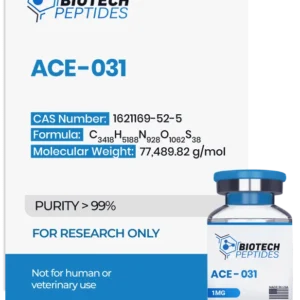
ACE-031 (1mg)
ACE-031 (1mg) is offered by Biotech Peptides for laboratory and analytical research. ACE-031 is a soluble fusion protein comprising the extracellular domain of activin receptor type IIB fused to the Fc portion of human IgG1, studied in relation to myostatin signaling and muscle-mass regulation. 1198
-
Product: ACE-031
-
Alternative name: Ramatercept
-
Listed quantity: 1 mg
-
Reference molecular weight: 77.24 kDa
-
Intended use: Laboratory and analytical research only
Review the manufacturer specifications and applicable analytical documentation before selecting material for your protocol.
For research use only. Not for human consumption.
MGF (Mechano-Growth Factor) (5mg)
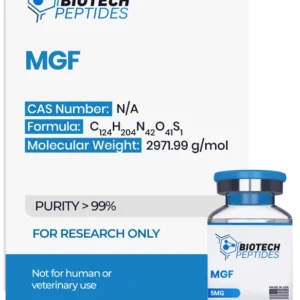
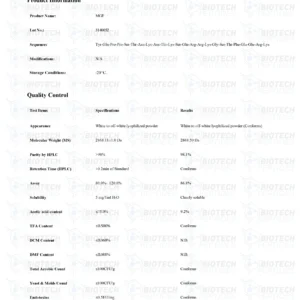
MGF (Mechano-Growth Factor) (5mg) is offered by Biotech Peptides for laboratory and analytical research. MGF is a synthetic 24-residue peptide derived from the E-domain of IGF-1Ec, studied in relation to muscle-cell proliferation, tissue-repair signaling, and cardiac ischemia models. 1065
-
Product: MGF
-
Full name: Mechano-Growth Factor
-
Listed quantity: 5 mg
-
Reference molecular formula: C₁₂₄H₂₀₄N₄₂O₄₁S
-
Intended use: Laboratory and analytical research only
Review the manufacturer specifications and applicable analytical documentation before selecting material for your protocol.
For research use only. Not for human consumption.
Nonapeptide-1 (200mg)
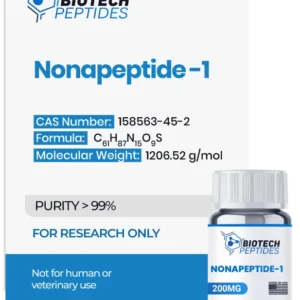
- Product: Nonapeptide-1
- Alternative name: Melanostatine-5
- Listed quantity: 200mg
- Peptide length: 9 amino acids
- Reference sequence: Met-Pro-D-Phe-Arg-D-Trp-Phe-Lys-Pro-Val-NH₂
- CAS number: 158563-45-2
Pal-GHK (Palmitoyl Tripeptide-1) (200mg) | Biotech Peptides
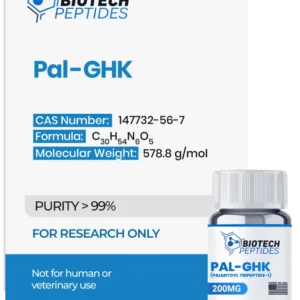
Pal-GHK (Palmitoyl Tripeptide-1) (200mg) is a synthetic, lipid-modified tripeptide listed for laboratory and analytical research involving peptide chemistry and skin-related research models.
Also known as Palmitoyl-Gly-His-Lys, Pal-GHK consists of a palmitoyl group attached to the N-terminus of the GHK tripeptide sequence. It has been investigated in research involving extracellular matrix components and topical cosmetic formulations. Reference molecular information:- Listed quantity: 200mg
- Peptide sequence: Gly-His-Lys (GHK)
- N-terminal modification: Palmitoyl group
- Molecular formula: C₃₀H₅₄N₆O₅
- Molecular weight: 578.8 g/mol
- CAS number: 147732-56-7
- Common name: Palmitoyl Tripeptide-1
Selank (10mg)
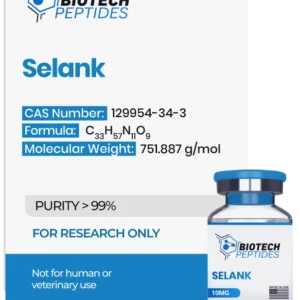
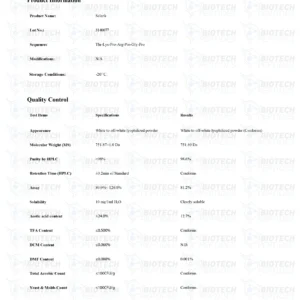
Selank (10mg) is offered by Biotech Peptides for laboratory and analytical research. Selank is a synthetic 7-residue analogue of tuftsin studied in relation to GABAergic signaling, immune modulation, and neurotrophic factor expression. 1166
-
Product: Selank
-
Full name: Tuftsin-Pro-Gly-Pro
-
Listed quantity: 10 mg
-
Reference molecular formula: C₃₃H₅₇N₁₁O₉
-
Intended use: Laboratory and analytical research only
Review the manufacturer specifications and applicable analytical documentation before selecting material for your protocol.
For research use only. Not for human consumption.
Semax (25mg)
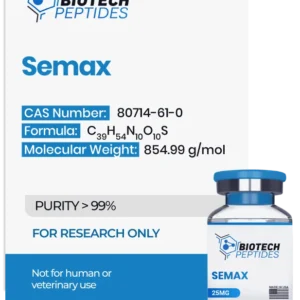
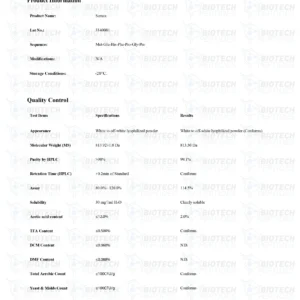
Semax (25mg) is offered by Biotech Peptides for laboratory and analytical research. Semax is a synthetic heptapeptide analogue of ACTH(4-10) studied in relation to neurotrophin gene expression and ischemic injury models. 1041
-
Product: Semax
-
Full name: ACTH(4-7)-Pro-Gly-Pro
-
Listed quantity: 25 mg
-
Reference molecular formula: C₃₉H₅₄N₁₀O₁₀S
-
Intended use: Laboratory and analytical research only
Review the manufacturer specifications and applicable analytical documentation before selecting material for your protocol.
For research use only. Not for human consumption.
TB-500 (Thymosin Beta-4) (5mg)
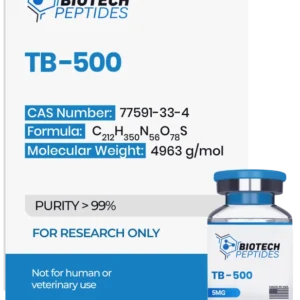
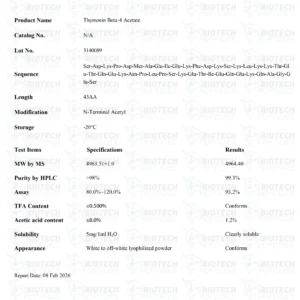
TB-500 (Thymosin Beta-4) (5mg) is offered by Biotech Peptides for laboratory and analytical research. TB-500 is a synthetic 43-residue peptide derived from thymosin beta-4, studied in relation to cell migration, angiogenesis, and wound-repair signaling. 1110
-
Product: TB-500
-
Full name: Thymosin Beta-4
-
Listed quantity: 5 mg
-
Reference molecular formula: C₂₁₂H₃₅₀N₅₆O₇₈S
-
Intended use: Laboratory and analytical research only
Review the manufacturer specifications and applicable analytical documentation before selecting material for your protocol.
For research use only. Not for human consumption.
Tesamorelin (5mg & 10mg)
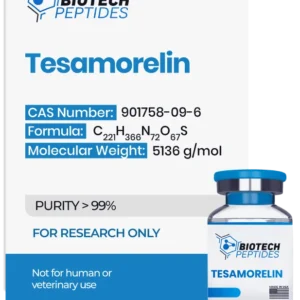
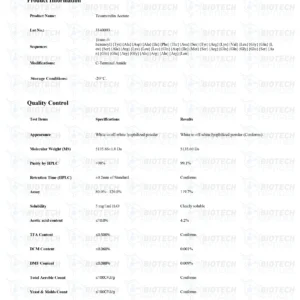
Tesamorelin (5mg & 10mg) is offered by Biotech Peptides for laboratory and analytical research. Tesamorelin is a synthetic 44-residue GHRH analogue studied in relation to growth hormone secretion, visceral adiposity, and metabolic signaling. 1137
-
Product: Tesamorelin
-
Full name: N-(trans-3-hexenoyl)-[Tyr1]-hGRF(1-44)-NH2 acetate
-
Listed quantities: 5 mg and 10 mg
-
Reference molecular formula: C₂₂₁H₃₆₆N₇₂O₆₇S
-
Intended use: Laboratory and analytical research only
Review the manufacturer specifications and applicable analytical documentation before selecting material for your protocol.
For research use only. Not for human consumption.