

Pal-AHK (200mg) | Biotech Peptides
Original price was: $192.00.$180.00Current price is: $180.00.
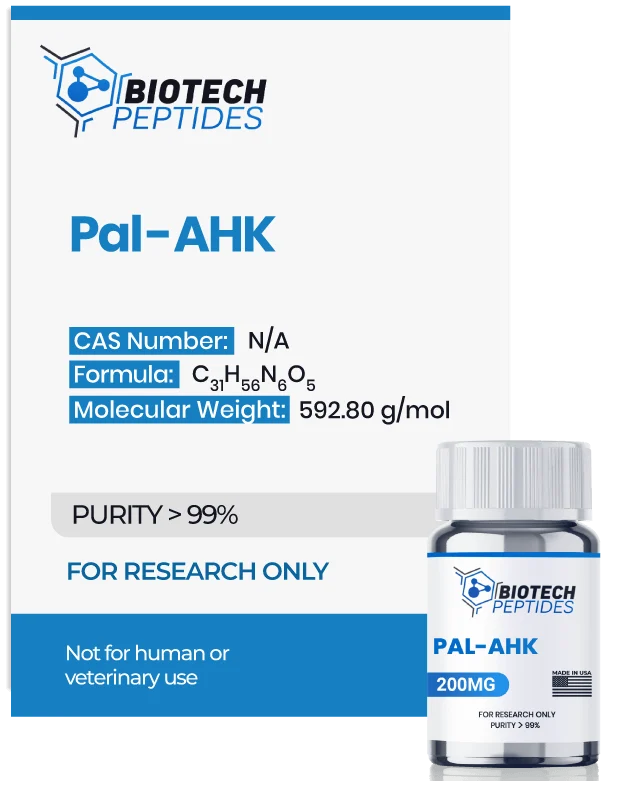
Pal-AHK (200mg) is listed as a palmitoylated AHK tripeptide for laboratory and analytical research. The supplied product description identifies the proposed structure as palmitoyl-Ala-His-Lys, combining an alanine-histidine-lysine peptide sequence with an N-terminal palmitoyl group.
Proposed reference characteristics (subject to manufacturer confirmation):
- Listed quantity: 200mg
- Proposed peptide sequence: Ala-His-Lys (AHK)
- Proposed modification: N-terminal palmitoyl group
- Proposed molecular formula: C₃₁H₅₆N₆O₅
- Proposed molecular weight: Approximately 592.8 g/mol
These structural values are calculated from the supplied proposed sequence and modification; they are not batch-specific analytical results or independently confirmed product specifications.
Explore the Biotech Peptides research peptide collection for additional laboratory research materials.
For laboratory and analytical research only. Not for human or animal consumption, personal administration, medical treatment, diagnosis, or veterinary application.
Pal-AHK (200mg) – Product Overview
Pal-AHK (200mg) is listed as a palmitoylated tripeptide for laboratory and analytical research. The supplied product description identifies its proposed structure as palmitoyl-Ala-His-Lys: an alanine-histidine-lysine (AHK) sequence with a palmitoyl group attached to the peptide.
Palmitoylation is the attachment of a palmitoyl group, derived from palmitic acid, to a molecule. This modification can change a peptide’s physicochemical properties, including its interaction with lipid environments. However, the effects of this modification on Pal-AHK itself have not been established in the published research identified for this review.
The exact identity and naming of this listing require manufacturer confirmation. The information below therefore distinguishes the proposed structure from verified product specifications.
Pal-AHK Product Information
| Attribute | Current information |
|---|---|
| Product name | Pal-AHK |
| Listed quantity | 200mg |
| Proposed compound class | Palmitoylated tripeptide |
| Proposed peptide sequence | Ala-His-Lys (AHK) |
| Proposed modification | N-terminal palmitoyl group |
| Proposed molecular formula | C₃₁H₅₆N₆O₅ |
| Proposed molecular weight | Approximately 592.8 g/mol |
| Chemical identity | Requires manufacturer confirmation |
| Batch-specific analytical data | Not supplied |
Important: The proposed formula and molecular weight are calculated from the supplied structural description, assuming an N-terminal palmitoyl modification, L-amino-acid residues and a free C-terminal carboxylic acid. They should not be presented as independently verified reference-database specifications.
Understanding the Proposed Pal-AHK Structure
The proposed Pal-AHK structure contains two components:
- AHK tripeptide: Alanine, histidine and lysine linked in sequence.
- Palmitoyl modification: A 16-carbon fatty-acid-derived group attached to the N-terminus.
The unmodified AHK tripeptide is a separate chemical entity from its palmitoylated derivative. Adding a palmitoyl group changes the molecular composition and may alter properties such as lipid affinity.
The proposed Pal-AHK structure should also be distinguished from AHK-Cu, which is a copper complex of the unpalmitoylated AHK tripeptide.
Scientific Research Background
Research on AHK-Cu and Hair Follicle Models
A published 2007 study by Pyo and colleagues investigated L-alanyl-L-histidyl-L-lysine complexed with copper(II), known as AHK-Cu.
The researchers examined two experimental systems:
- Ex vivo human hair follicles: Isolated follicles maintained in an experimental culture system.
- In vitro dermal papilla cells: Specialized cells cultured outside the body that are involved in hair-follicle biology.
The study reported that AHK-Cu stimulated human hair-follicle elongation ex vivo and increased dermal papilla cell proliferation in vitro. It also examined apoptosis-associated proteins, including Bcl-2, Bax, cleaved caspase-3 and PARP.
The reduction in apoptotic cell numbers reported at the tested concentration was not statistically significant. The findings are therefore best interpreted as preliminary laboratory observations.
This study did not investigate Pal-AHK. It evaluated the copper complex of unpalmitoylated AHK. Its results cannot establish the biological activity, skin penetration, hair-follicle effects or safety of the Pal-AHK material listed here.
Read the original study: The Effect of Tripeptide-Copper Complex on Human Hair Growth In Vitro (2007).
AHK and Copper-Complex Research
AHK is a short peptide sequence that has been investigated in copper-complex research. Copper coordination produces a distinct chemical species with properties that may differ from those of the uncomplexed peptide.
This distinction matters when interpreting published research. Results obtained with AHK-Cu cannot automatically be assigned to unmodified AHK, and neither compound is interchangeable with a proposed palmitoylated AHK derivative.
For reference information about the unmodified AHK sequence, see PubChem’s AHK record.
Research Specific to Pal-AHK
No directly applicable peer-reviewed study of the proposed palmitoyl-Ala-His-Lys compound was identified in the sources reviewed for this product description.
In particular, the available AHK-Cu hair-follicle findings do not establish:
- Pal-AHK activity in dermal papilla cells
- Pal-AHK effects on hair-follicle elongation
- Pal-AHK effects on collagen production
- Pal-AHK antioxidant activity
- Pal-AHK skin penetration or absorption
- Pal-AHK safety or effectiveness in humans or animals
These questions would require experiments using a chemically verified Pal-AHK material.
Important Naming and Identity Distinctions
The name Palmitoyl Tripeptide-3 should not be treated as a confirmed synonym for the proposed Pal-AHK structure.
The Cosmetic Ingredient Review’s assessment of palmitoyl oligopeptides discusses inconsistencies in historical cosmetic ingredient naming. It notes that Palmitoyl Tripeptide-3 has been listed as a technical name for Palmitoyl Tripeptide-5 in the cosmetic ingredient dictionary.
That is a different naming context from the proposed palmitoyl-Ala-His-Lys sequence.
For this reason, the product should be identified by its proposed sequence and chemical modification only after the manufacturer confirms them. A similar name or peptide length is not sufficient to establish chemical identity.
Reference: Cosmetic Ingredient Review – Safety Assessment of Palmitoyl Oligopeptides.
Documentation and Batch Verification
The proposed structure and calculated molecular characteristics are not evidence of the identity or quality of the specific product batch.
Before relying on the material for analytical work, researchers should request documentation confirming:
- The amino-acid sequence and stereochemistry
- The presence and attachment position of the palmitoyl group
- The terminal groups and chemical form
- The calculated and experimentally observed molecular mass
- Batch-specific identity testing
- Available purity and quantity assay results
Mass spectrometry can help distinguish the proposed palmitoyl-AHK structure from related compounds. Sequence-specific analysis is also important because closely related peptides may differ by only one amino-acid residue.
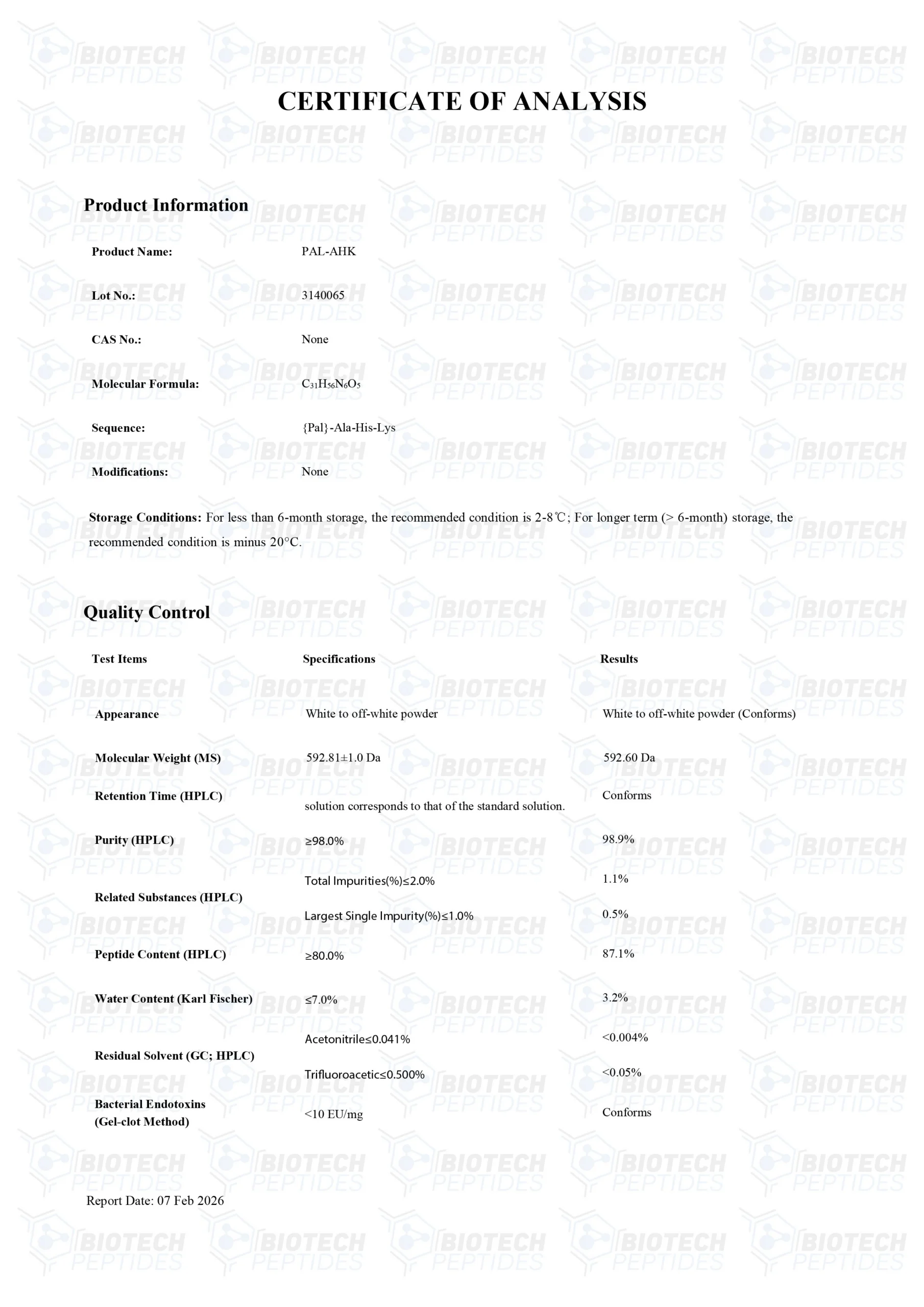
No batch-specific COA, HPLC result, mass-spectrometry result, purity percentage, sterility result or endotoxin result has been supplied for this listing.
The listed 200mg quantity should be understood as the product’s stated quantity, not as independently verified peptide content.
Storage and Handling
Follow the applicable manufacturer instructions and product-specific documentation for storage and handling.
No verified storage temperature, shelf life or stability period has been supplied for this product. Specific conditions should not be inferred from the properties of unmodified AHK or AHK-Cu.
Frequently Asked Questions
What is Pal-AHK?
Pal-AHK is the name used for a proposed palmitoylated form of the AHK tripeptide, consisting of alanine, histidine and lysine. The exact identity of the material listed here requires manufacturer confirmation.
What is the proposed sequence of Pal-AHK?
The supplied description gives the proposed structure as palmitoyl-Ala-His-Lys. The amino-acid stereochemistry and terminal groups should be confirmed by the manufacturer.
Is Pal-AHK the same as AHK-Cu?
No. AHK-Cu is a copper complex of the AHK tripeptide. Pal-AHK is described as an AHK peptide modified with a palmitoyl group. They are chemically distinct proposed materials and should not be treated as interchangeable.
What is the listed quantity?
The product is listed as 200mg. This is the stated product quantity and does not independently establish measured peptide content or assay.
What research is available on Pal-AHK?
No directly applicable published research on the proposed Pal-AHK structure was identified in the sources reviewed. AHK-Cu has been investigated in an ex vivo human hair-follicle model and cultured dermal papilla cells, but those findings do not establish activity for Pal-AHK.
Is this product intended for human or animal use?
No. This product is offered for laboratory and analytical research only. It is not intended for human or animal consumption, personal administration, medical treatment, diagnosis or veterinary application.
Explore Research Peptides
Explore the Biotech Peptides research peptide collection for additional compounds listed for laboratory and analytical research.
For information about order processing and delivery arrangements, review the Shipping Policy.
Please also read the Research Use Only notice before purchasing.
Research-use restriction: For laboratory and analytical research only. Not for human or animal consumption, personal administration, medical treatment, diagnosis, or veterinary application.
| Brand | Biotech Peptides |
|---|
Related products


ACE-031 (1mg)
ACE-031 (1mg) is offered by Biotech Peptides for laboratory and analytical research. ACE-031 is a soluble fusion protein comprising the extracellular domain of activin receptor type IIB fused to the Fc portion of human IgG1, studied in relation to myostatin signaling and muscle-mass regulation. 1198
-
Product: ACE-031
-
Alternative name: Ramatercept
-
Listed quantity: 1 mg
-
Reference molecular weight: 77.24 kDa
-
Intended use: Laboratory and analytical research only
Review the manufacturer specifications and applicable analytical documentation before selecting material for your protocol.
For research use only. Not for human consumption.

Acetyl Hexapeptide-3 (Argireline) (200mg)
- Product: Acetyl Hexapeptide-3 (Argireline)
- Listed quantity: 200mg
- Alternative name: Acetyl Hexapeptide-8
- Sequence: Ac-Glu-Glu-Met-Gln-Arg-Arg-NH₂
- CAS number: 616204-22-9
- Research area: SNAP-25 and SNARE-complex interactions
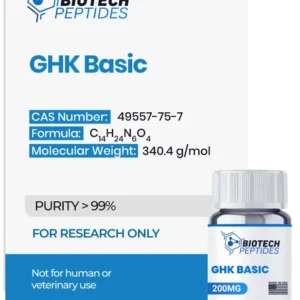
GHK Basic Tripeptide-1 (200mg) | Biotech Peptides
- Product: GHK Basic (Tripeptide-1)
- Listed quantity: 200mg
- Peptide sequence: Gly-His-Lys
- Molecular formula: C₁₄H₂₄N₆O₄
- Molecular weight: Approximately 340.38 g/mol
- CAS number: 49557-75-7
- Chemical form: Copper-free GHK reference structure
Sermorelin (5mg)
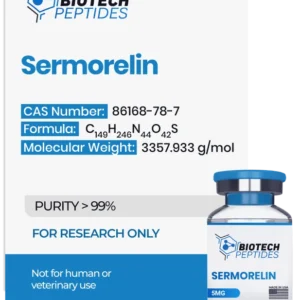
Sermorelin (5mg) is offered by Biotech Peptides for laboratory and analytical research. Sermorelin is a synthetic 29-residue GHRH analogue studied in relation to growth hormone secretion, receptor signaling, and neuroendocrine pathways. 1159
-
Product: Sermorelin
-
Full name: GHRH(1-29)-NH2
-
Listed quantity: 5 mg
-
Reference molecular formula: C₁₄₉H₂₄₆N₄₄O₄₂S
-
Intended use: Laboratory and analytical research only
Review the manufacturer specifications and applicable analytical documentation before selecting material for your protocol.
For research use only. Not for human consumption.


TB-500 (Thymosin Beta-4) (10mg)
TB-500 (Thymosin Beta-4) (10mg) is offered by Biotech Peptides for laboratory and analytical research. TB-500 is a synthetic 43-residue peptide derived from thymosin beta-4, studied in relation to cell migration, angiogenesis, and wound-repair signaling. 1153
-
Product: TB-500
-
Full name: Thymosin Beta-4
-
Listed quantity: 10 mg
-
Reference molecular formula: C₂₁₂H₃₅₀N₅₆O₇₈S
-
Intended use: Laboratory and analytical research only
Review the manufacturer specifications and applicable analytical documentation before selecting material for your protocol.
For research use only. Not for human consumption.
Thymalin (25mg)
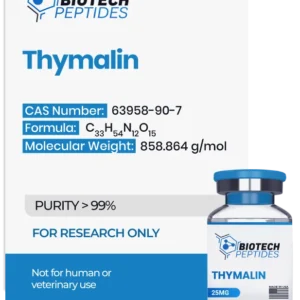
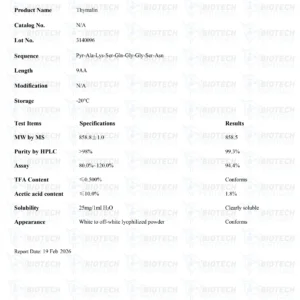
Thymalin (25mg) is offered by Biotech Peptides for laboratory and analytical research. Thymalin is a synthetic 9-residue peptide, also called thymulin, studied in relation to immune modulation, cytokine signaling, and neuroendocrine pathways. 1226
-
Product: Thymalin
-
Alternative name: Thymulin
-
Listed quantity: 25 mg
-
Reference molecular formula: C₃₃H₅₄N₁₂O₁₅
-
Intended use: Laboratory and analytical research only
Review the manufacturer specifications and applicable analytical documentation before selecting material for your protocol.
For research use only. Not for human consumption.
Thymosin Alpha-1 (10mg)
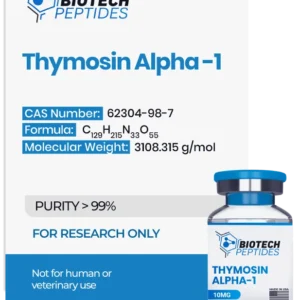
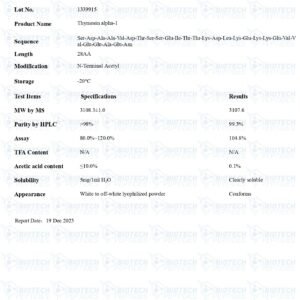
Thymosin Alpha-1 (10mg) is offered by Biotech Peptides for laboratory and analytical research. Thymosin Alpha-1 is a synthetic 28-residue peptide, also called thymalfasin, studied in relation to immune modulation, toll-like receptor signaling, and antiviral research. 1213
-
Product: Thymosin Alpha-1
-
Alternative name: Thymalfasin
-
Listed quantity: 10 mg
-
Reference molecular formula: C₁₂₉H₂₁₅N₃₃O₅₅
-
Intended use: Laboratory and analytical research only
Review the manufacturer specifications and applicable analytical documentation before selecting material for your protocol.
For research use only. Not for human consumption.