

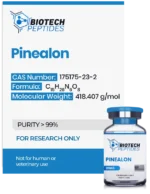
Pinealon (20mg)
$68.00
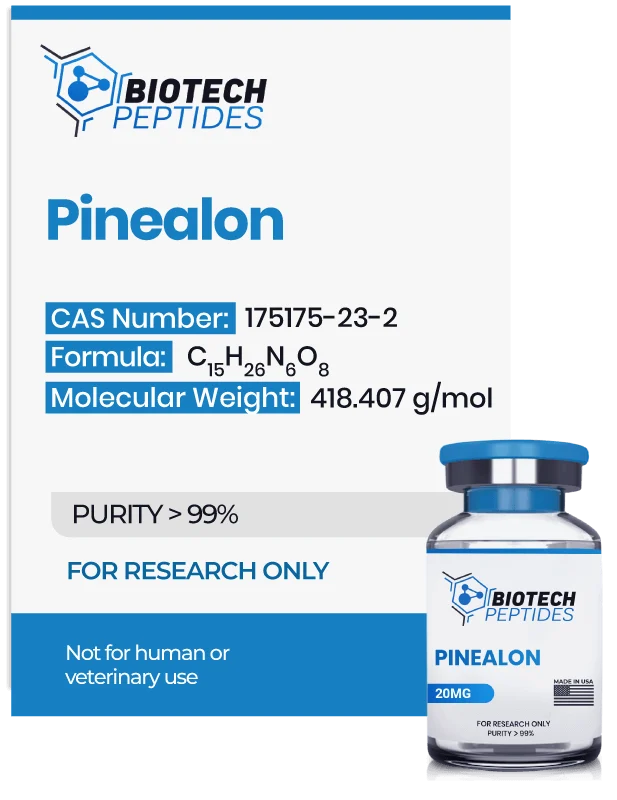
Pinealon (20mg) is offered by Biotech Peptides for laboratory and analytical research. Also called EDR, this three-amino-acid peptide has been studied in experimental models of oxidative stress, cell viability, and neuronal responses.pubmed.ncbi.nlm.nih+1
-
Product: Pinealon
-
Alternative name: EDR
-
Listed quantity: 20 mg
-
Reference sequence: Glu-Asp-Arg
-
Intended use: Laboratory and analytical research only
Review the manufacturer specifications and applicable analytical documentation before selecting material for your protocol.
For research use only. Not for human consumption.
Pinealon (20mg) for Laboratory Research
Pinealon (20mg) is offered by Biotech Peptides for laboratories investigating short-peptide biology, oxidative-stress models, and cell-viability research. Pinealon is the tripeptide Glu-Asp-Arg, commonly abbreviated EDR.pubmed.ncbi.nlm.nih+1
For laboratories looking to buy Pinealon, this listing identifies a 20 mg quantity. Confirm the supplied material’s sequence, terminal groups, chemical form, and analytical characteristics against the requirements of the intended work.
Explore our research peptides for sale to review other laboratory-use listings.
Pinealon Product Information
| Property | Listing information |
|---|---|
| Product name | Pinealon |
| Alternative name | EDR |
| Listed quantity | 20 mg |
| Intended application | Laboratory and analytical research |
| Documentation inquiries | Include the product name and batch or lot number, where available |
The 20 mg designation describes the quantity stated for this listing. It does not independently establish net peptide content or confirm that a particular quantity-assay method has been performed.
Pinealon Reference Molecular Characteristics
The following characteristics describe the unmodified Pinealon reference structure. They are not analytical confirmation of an individual commercial batch.
| Reference characteristic | Information |
|---|---|
| Peptide length | Three amino acids |
| Amino-acid sequence | Glu-Asp-Arg |
| One-letter sequence | EDR |
| Chemical name | L-glutamyl-L-aspartyl-L-arginine |
| Reference terminal groups | Free N-terminus and C-terminal carboxylic acid |
| Molecular formula | C₁₅H₂₆N₆O₈ |
| Approximate molecular weight | 418.40 g/mol |
| PubChem compound identifier | 10273502 |
The sequence, molecular formula, molecular weight, and terminal-group description are documented in the PubChem Pinealon reference record. Confirm the supplied chemical form and any counterions against manufacturer specifications before using reference values in analytical calculations.
Pinealon and Oxidative-Stress Research
A 2011 study by Khavinson and colleagues examined Pinealon in cerebellar granule cells, neutrophils, and PC12 pheochromocytoma cells. The investigators reported dose-dependent restriction of reactive oxygen species accumulation under oxidative-stress conditions and reduced necrotic cell death measured by propidium iodide staining.
The same study reported a delayed time course of ERK 1/2 activation and cell-cycle modification. The authors interpreted the findings as consistent with antioxidant activity and possible direct interaction with the cell genome under the conditions studied
Read the primary study of Pinealon and oxidative stress for the experimental models, concentrations, and findings.
DNA and Gene-Expression Research
A review of EDR peptide research describes proposed interactions with histone proteins or ribonucleic acids, rather than conventional cell-surface or cytoplasmic receptor binding. The review also states that EDR has been reported to enter cells and bind to histone proteins or RNA.
A separate systematic review discusses molecular-dynamics work suggesting possible interactions between EDR and double-stranded DNA sequences in promoter regions of genes associated with Alzheimer’s disease research. These are computational and experimental research findings, not proof that Pinealon modifies human gene expression in a predictable or clinically useful way.
Read the review of EDR peptide mechanisms for the proposed molecular context and evidence limitations.
Neuronal and Developmental Models
A study of rat offspring exposed to experimental prenatal hyperhomocysteinemia reported improved spatial orientation and learning ability, along with reduced reactive oxygen species accumulation and fewer necrotic neurons in cerebellar tissue after Pinealon administration to pregnant rats.
These findings apply to a specific rodent developmental model and experimental exposure conditions. They do not establish cognitive benefits, neuroprotection, or safety in humans.
Read the primary rat-offspring study for the model, methods, and limitations.
Distinguishing Pinealon From Other Peptides
Before applying a publication to your protocol, confirm that its experimental material matches the supplied peptide.
Do not assume that “Pinealon,” “EDR,” “T-33,” or “Cortexin” identifies the same material. Cortexin is a complex polypeptide preparation, while Pinealon is the defined tripeptide Glu-Asp-Arg. A result obtained using Cortexin or another peptide bioregulator should not be presented as verified evidence for an isolated Pinealon batch.pubchem.ncbi.nlm.nih+1
Research Limitations
The studies discussed here examine cultured cells, oxidative-stress models, and rodent experiments. They do not establish that Pinealon treats sleep disorders, circadian-rhythm disruption, depression, stroke, myocardial infarction, aging, or any other condition.pubmed.ncbi.nlm.nih+2
Published research also does not verify the identity, purity, quantity, or biological activity of the commercial batch supplied with this listing.
Documentation and Batch Verification
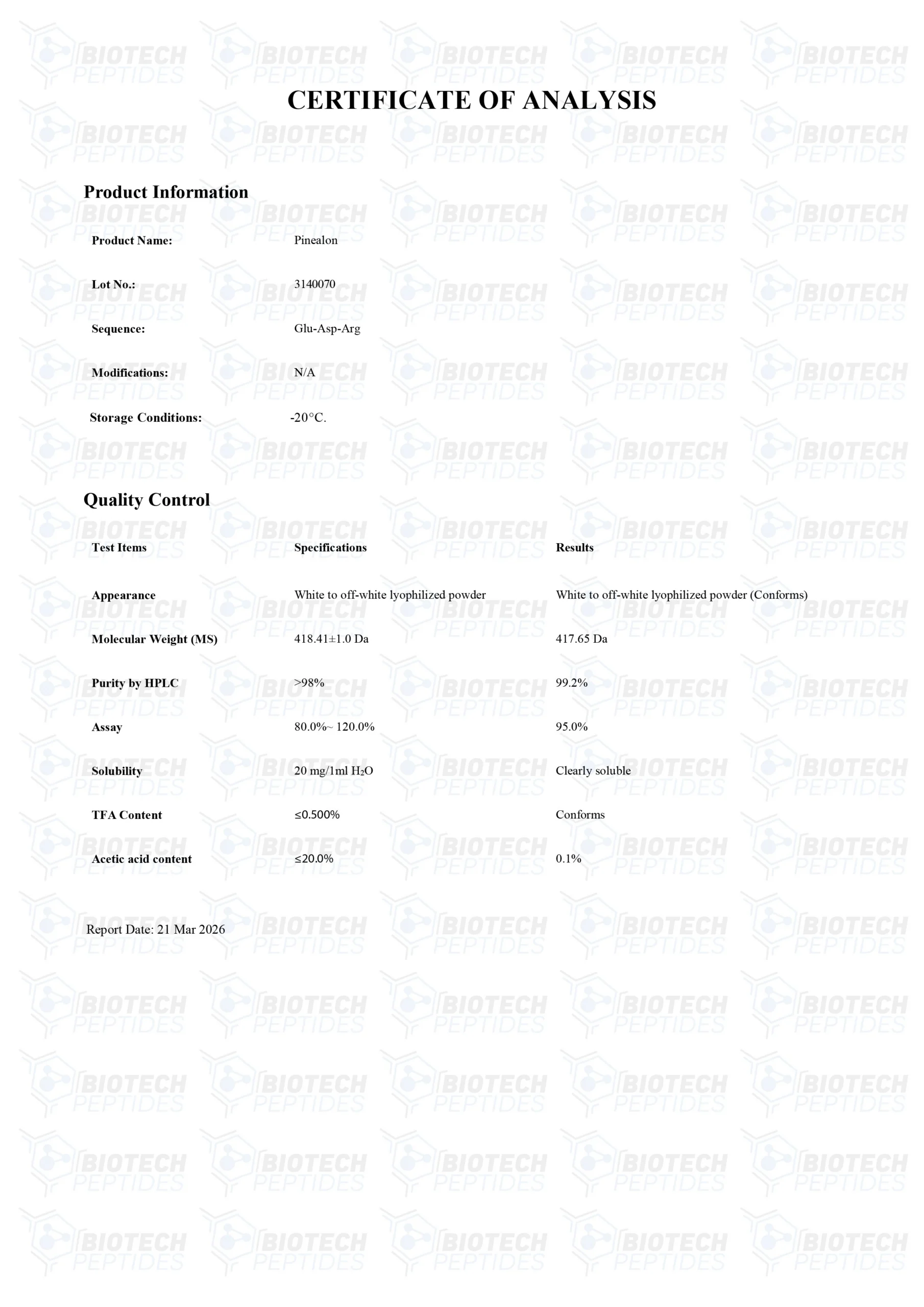
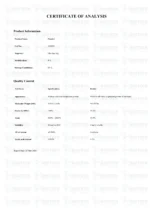
Before selecting Pinealon (20mg), review the information associated with the exact material being supplied. Depending on your protocol, relevant documentation may include:
-
Product name and batch or lot identifier.
-
Manufacturer specifications and chemical form.
-
Complete sequence and terminal-group information.
-
Counterion information, where applicable.
-
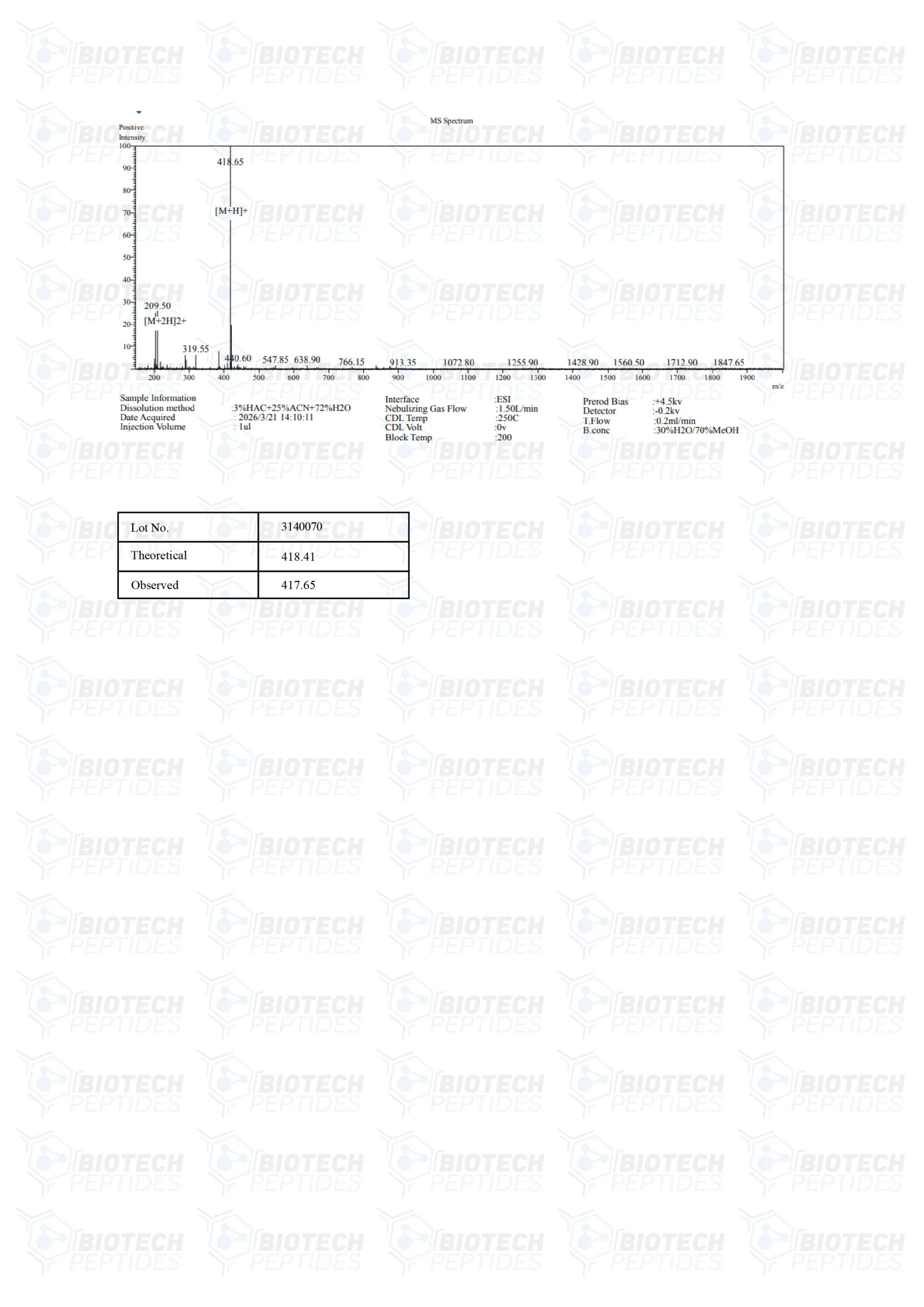
Identity-testing methods and reported results.
-
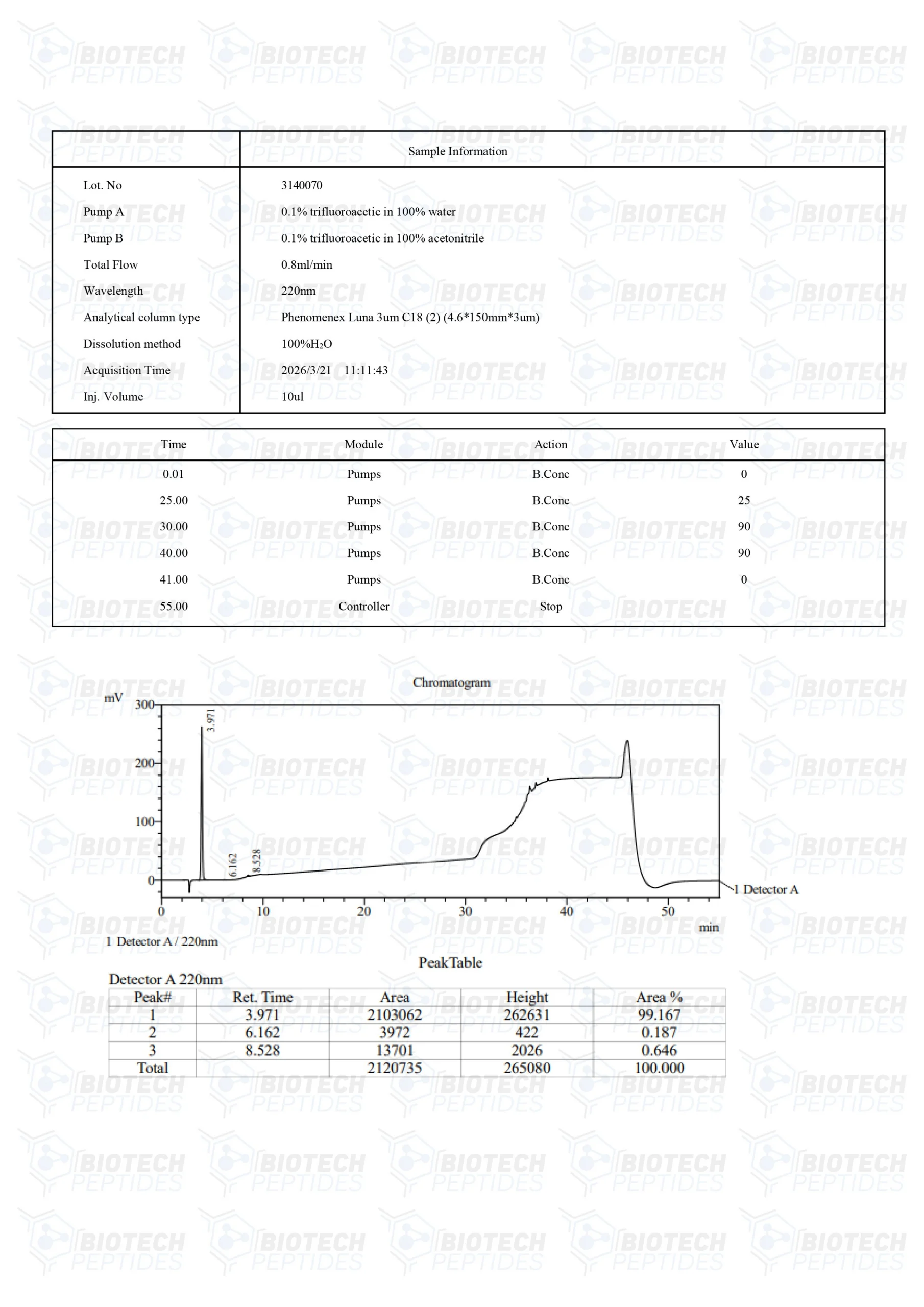
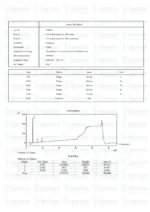
Purity-testing methods and supporting analytical data.
-
Quantity or peptide-content measurements, where required.
-
Product-specific storage and handling instructions.
Match identifiers across the label, specifications, and analytical reports. Obtain clarification if the documentation uses inconsistent names, sequences, or molecular values.
For inquiries, provide “Pinealon (20mg),” the batch number where available, and the specific information your laboratory requires.
Storage and Handling
Follow the product-specific instructions supplied with the material and your laboratory’s applicable procedures.
Do not transfer storage temperatures, shelf-life claims, or preparation instructions from another supplier’s formulation or a differently modified peptide. Obtain clarification if documented instructions are unavailable or unclear.
Frequently Asked Questions About Pinealon (20mg)
What is Pinealon?
Pinealon is the tripeptide Glu-Asp-Arg, also abbreviated EDR. It is a synthetic short peptide that has been studied in experimental oxidative-stress and cell-viability models.pubmed.ncbi.nlm.nih+1
Is Pinealon the same as Cortexin?
No. Pinealon is the defined tripeptide EDR. Cortexin is a complex polypeptide preparation in which EDR-related activity has been discussed, but the two materials are not interchangeable.pubchem.ncbi.nlm.nih+1
Does Pinealon bind directly to DNA?
Research has reported nuclear entry and DNA or oligonucleotide interactions in specific experimental systems. These findings do not establish direct DNA binding, predictable gene regulation, or clinical effects for every Pinealon preparation or exposure condition.pubmed.ncbi.nlm.nih+1
What does the 20mg designation mean?
It is the quantity stated for this listing. It does not describe a concentration or independently establish net peptide content.
Does published research verify this product?
No. Publications describe the materials and conditions used by the investigators. Assess a commercial batch using relevant manufacturer specifications and analytical evidence.
Where can I find delivery information?
Review our shipping information for current order-processing and delivery terms.
Research Use Only
Pinealon (20mg) is sold for laboratory and analytical research only. Not for human or animal consumption, personal administration, medical treatment, diagnosis, or veterinary application.
Review our Research-Use-Only Policy before ordering.
| Brand | Biotech Peptides |
|---|
Related products
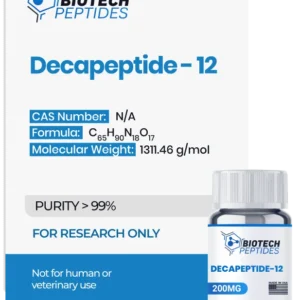
Decapeptide-12 (200mg)
Decapeptide-12 (200mg), also known by its sequence YRSRKYSSWY, is a synthetic ten-amino-acid peptide investigated for its interaction with tyrosinase and its role in experimental melanogenesis research. Published studies have examined its effects on tyrosinase activity and melanin content in laboratory models. Listed for laboratory and analytical research.
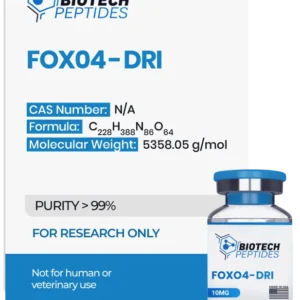
FOXO4-DRI (Proxofim) (10mg)
FOXO4-DRI (Proxofim) (10mg) is offered by Biotech Peptides for laboratory and analytical research. FOXO4-DRI is a synthetic D-retro-inverso peptide, also called Proxofim, studied in relation to FOXO4-p53 signaling and senescent-cell apoptosis. 1241
-
Product: FOXO4-DRI
-
Alternative name: Proxofim
-
Listed quantity: 10 mg
-
Reference molecular formula: C₂₂₈H₃₈₈N₈₆O₆₄
-
Intended use: Laboratory and analytical research only
Review the manufacturer specifications and applicable analytical documentation before selecting material for your protocol.
For research use only. Not for human consumption.


MGF (Mechano-Growth Factor) (5mg)
MGF (Mechano-Growth Factor) (5mg) is offered by Biotech Peptides for laboratory and analytical research. MGF is a synthetic 24-residue peptide derived from the E-domain of IGF-1Ec, studied in relation to muscle-cell proliferation, tissue-repair signaling, and cardiac ischemia models. 1065
-
Product: MGF
-
Full name: Mechano-Growth Factor
-
Listed quantity: 5 mg
-
Reference molecular formula: C₁₂₄H₂₀₄N₄₂O₄₁S
-
Intended use: Laboratory and analytical research only
Review the manufacturer specifications and applicable analytical documentation before selecting material for your protocol.
For research use only. Not for human consumption.
Nonapeptide-1 (200mg)
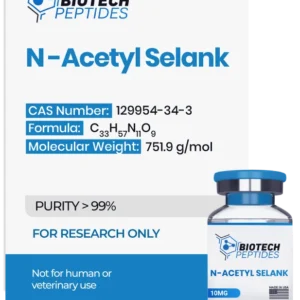
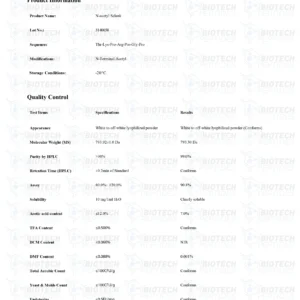
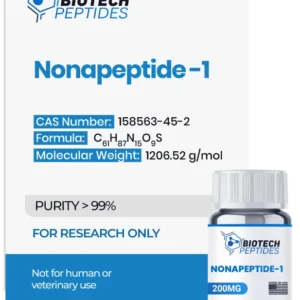
- Product: Nonapeptide-1
- Alternative name: Melanostatine-5
- Listed quantity: 200mg
- Peptide length: 9 amino acids
- Reference sequence: Met-Pro-D-Phe-Arg-D-Trp-Phe-Lys-Pro-Val-NH₂
- CAS number: 158563-45-2
Pal-GHK (Palmitoyl Tripeptide-1) (200mg) | Biotech Peptides
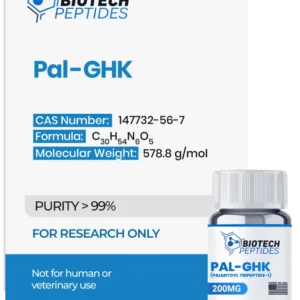
Pal-GHK (Palmitoyl Tripeptide-1) (200mg) is a synthetic, lipid-modified tripeptide listed for laboratory and analytical research involving peptide chemistry and skin-related research models.
Also known as Palmitoyl-Gly-His-Lys, Pal-GHK consists of a palmitoyl group attached to the N-terminus of the GHK tripeptide sequence. It has been investigated in research involving extracellular matrix components and topical cosmetic formulations. Reference molecular information:- Listed quantity: 200mg
- Peptide sequence: Gly-His-Lys (GHK)
- N-terminal modification: Palmitoyl group
- Molecular formula: C₃₀H₅₄N₆O₅
- Molecular weight: 578.8 g/mol
- CAS number: 147732-56-7
- Common name: Palmitoyl Tripeptide-1
PT-141 (Bremelanotide) (10mg)
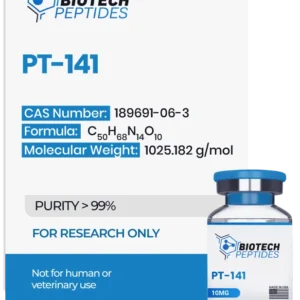
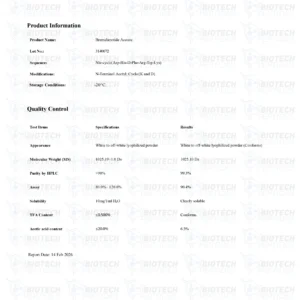
PT-141 (Bremelanotide) (10mg) is offered by Biotech Peptides for laboratory and analytical research. Also called bremelanotide, this synthetic cyclic heptapeptide is a melanocortin receptor agonist studied in relation to MC1R, MC3R, and MC4R signaling.accessdata.fda+2
-
Product: PT-141 (Bremelanotide)
-
Alternative name: Bremelanotide
-
Listed quantity: 10 mg
-
Reference molecular formula: C₅₀H₆₈N₁₄O₁₀
-
Intended use: Laboratory and analytical research only
Review the manufacturer specifications and applicable analytical documentation before selecting material for your protocol.
For research use only. Not for human consumption.
